Materials normally move when an external force pushes, pulls or heats them. A new set of experiments challenges that passive picture. Researchers from Amsterdam, Cambridge and the University of New South Wales have built active structures whose internal motors and mechanical connections allow them to repeatedly buckle and snap. The resulting motion can resemble crawling, walking or digging. Related work shows that making individual components more active does not always make an entire network more responsive. The findings suggest that future soft robots may depend as much on the architecture of their materials as on the power of their motors.
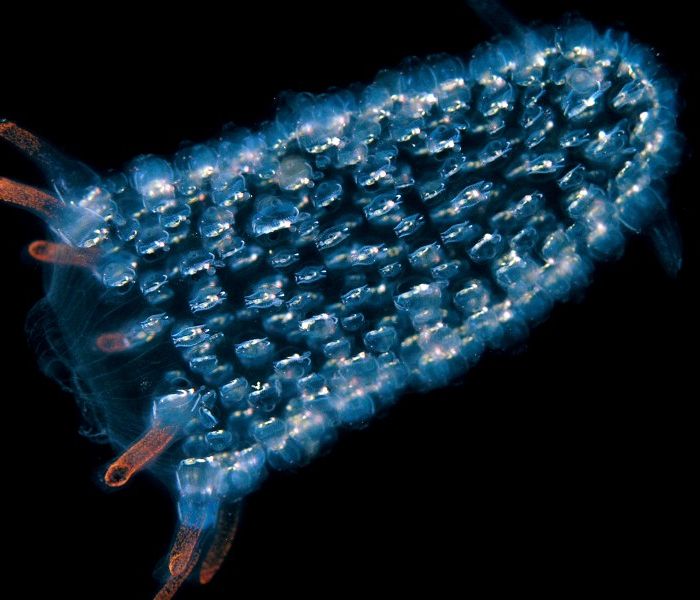
Image by the authors; courtesy of the University of Amsterdam.
Research timing: the University of Amsterdam highlighted the findings on 23 November 2026. The two peer-reviewed papers discussed below were published earlier in 2026, in March and April.
A material that does not wait to be pushed
Most familiar materials are passive. A rubber band stretches when pulled, a metal beam bends under a load and a block of concrete changes shape when a force is applied. The energy comes from outside the material. Active matter is different because its components consume energy internally and can generate motion or force without a conventional external push. Natural examples include groups of cells, bacterial colonies and flocks of animals, where many local agents interact to create coordinated behaviour.
The new work brings that idea into engineered structures. Researchers connected miniature motors, rods and elastic elements so that one part could influence another in a way that was not mechanically reciprocal. When the system was disturbed, the chain did not simply bend once and settle. It could buckle and snap repeatedly, producing sustained oscillations. That behaviour creates the possibility of designing materials that perform a sequence of mechanical actions through their own internal dynamics.
How a chain can turn instability into motion
The PNAS study, led by researchers including Sami Al-Izzi and Yao Du, examines active filaments whose mechanical interactions are non-reciprocal. In an ordinary passive chain, the response between two connected elements follows familiar constraints. In an active system, the internal motors can change how forces are transmitted, allowing a deformation in one part to affect its neighbour differently from the reverse interaction.
The researchers found that a chain can move through repeated buckling and snapping rather than a single collapse. The behaviour is associated with a change in the critical point that governs the onset of snapping. The paper describes a critical exceptional point, a feature of the system’s dynamics that allows an unstable configuration to generate sustained oscillations. The key result is not that a finished walking robot has been delivered, but that a simple material architecture can produce a repertoire of motion without a separate motor being attached to every joint.
Why the movements resemble crawling, walking and digging
The repeated buckling of an active chain can create directional movement when it interacts with a surface or surrounding material. Depending on how the structure is constrained and how its components are arranged, the same underlying mechanism can produce different forms of motion. A chain may advance through a sequence of local shape changes, push into a granular environment or move in a way that resembles a small organism.
This matters because conventional robots often depend on many separately controlled actuators, sensors and power connections. A material that embeds some of its behaviour into its own structure could reduce the need for complex control at every point. It may also be more adaptable when the environment is unpredictable. However, the experiments remain a controlled laboratory demonstration. Practical machines would still need reliable power delivery, durable materials, a way to sense their surroundings and a safe means of stopping or changing motion.
The surprising lesson: more activity can mean less response
A second study, published in Physical Review X, examined active networks rather than a single chain. It found that increasing the activity of individual components does not necessarily make the whole structure more responsive. What matters is whether active regions are connected in a way that allows their influence to travel across the material. If the network lacks connected pathways, energetic components may remain isolated and fail to move the structure as a whole.
The researchers use the concept of percolation to explain the effect. In a percolating network, local connections create a continuous path through which a signal or mechanical response can spread. If that pathway is broken, increasing activity in one isolated region may have little effect elsewhere. This is counterintuitive because engineers often assume that stronger local motors should produce stronger overall performance. The result suggests that material topology, connectivity and distribution of active components must be designed together.
What this means for soft robotics
Soft robotics aims to build machines that can bend, squeeze, adapt and interact safely with objects that are too delicate or irregular for rigid mechanisms. Examples include grippers for food handling, medical devices that navigate confined spaces, inspection tools and robots designed to move through debris or granular material. Active materials could offer a way to build motion directly into the body of a robot rather than relying on a large collection of discrete actuators.
A future device might use a network of active elements to generate a repeated movement pattern, while passive sections provide flexibility or structural support. Such a design could be useful where a robot must change shape to pass through an opening or move across a surface without a rigid wheel or leg assembly. But translating the laboratory physics into a product will require solutions to durability, power consumption, control, heat, manufacturing and repair. The new studies provide principles, not a commercial specification.
Connections to biology and living systems
Active materials are relevant to biology because living tissues are not simply passive substances. Cells consume chemical energy, generate forces and coordinate with neighbours through mechanical and biochemical signals. A sheet of cells can contract, a tissue can change shape and a group of organisms can organise movement without a central controller. The new research provides simplified physical models that can help scientists understand how local activity creates larger-scale behaviour.
The comparison should not be taken too far. A motor-and-rod network is not a living tissue, and the mechanisms that govern cell behaviour are much more complex. Still, the mathematics of non-reciprocal interactions and percolation may help researchers explore how active processes spread through biological systems. It could also inform the design of synthetic materials that respond to their environment in ways that are more robust than a conventional machine with one central control loop.
Where the research could be applied next
The most immediate applications are likely to be experimental platforms and specialised soft mechanisms rather than general-purpose robots. Researchers could investigate small crawling devices, self-adjusting grippers, material systems that move through granular media or structures that change shape in response to an external load. A material that performs repeated movements without a complex controller could be useful in settings where conventional electronics are difficult to protect or maintain.
The studies may also influence mechanical metamaterials, which are engineered structures whose geometry gives them unusual properties. Instead of relying only on the chemical composition of a material, designers can use the arrangement of its components to create specific responses. Active matter adds a further dimension: the structure can consume energy and generate motion. This opens questions about how to tune speed, direction, force, efficiency and stability, and how to ensure that the material behaves predictably when the environment changes.
The next challenge is reliable control
A material that can move by itself is not automatically useful. Engineers need to decide when it moves, where it moves and how it responds when an obstacle or unexpected force appears. They also need to understand how the structure behaves after repeated cycles, whether its components wear out and how much energy it consumes. For a practical robot, the ability to stop safely may be as important as the ability to start moving.
The new findings are valuable because they show that active behaviour can emerge from relatively simple mechanical ingredients. They also warn that local activity and system-level performance are not the same thing. The next generation of experiments will likely focus on controllable motion, robust networks and designs that can be manufactured at useful scales. If those problems can be solved, active materials could shift some of the intelligence of a robot from software and hardware into the physical structure itself.
Frequently asked questions
What are active materials?
Active materials contain components that consume energy internally and can generate forces or motion. Unlike passive materials, they do not rely entirely on an external push or pull to change shape.
Have scientists built a walking robot from this research?
No. The studies demonstrate material structures that can move in ways resembling crawling, walking and digging. They establish physical principles that may guide future soft robots, not a finished autonomous product.
Why can more active components make a network less responsive?
The overall response depends on connectivity. If active regions are not linked through continuous pathways, their local motion may not spread through the full structure. Network architecture can matter as much as local activity.