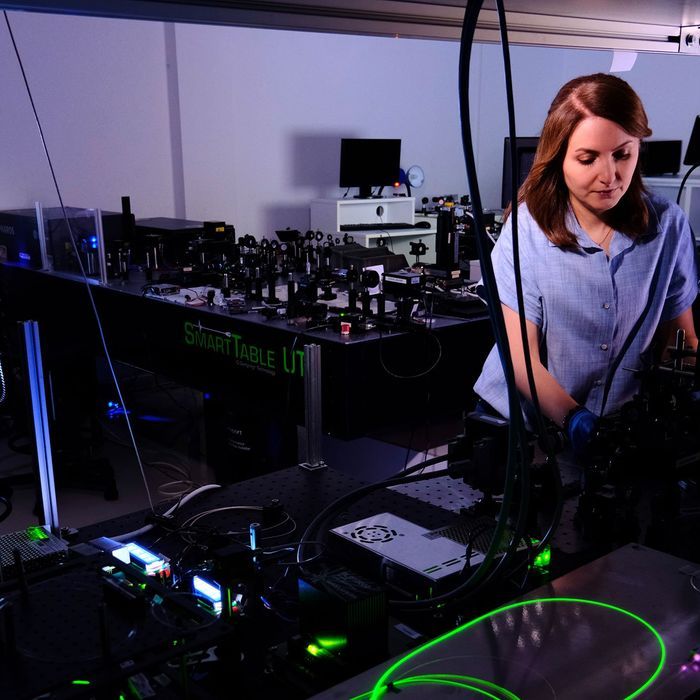
A Nature Physics experiment used microwave signals to drive two kinds of operation between electron qubits held close together on solid neon.
A peer-reviewed result for two interacting qubits
Researchers reported on 25 November that they had controlled interactions between electron qubits held on the surface of solid neon. In a paper published in Nature Physics, Xinhao Li and colleagues describe two kinds of operation that use the interaction between a pair of qubits. The experiment extends work on controlling individual electrons on neon. Its significance is that the researchers showed how the platform can begin to carry out operations that involve more than one unit of quantum information.
The paper describes cross-resonance and bSWAP operations, which the researchers drove using microwave signals applied globally. Electrons held sufficiently close together on the neon interacted strongly enough for the team to use that interaction in its experiments. The work deals with a small laboratory device. Its findings establish that the researchers could manipulate interacting qubits on that device, while the engineering needed to repeat the result across a large system remains open.
The journal publication follows an earlier preprint from the research team. The November paper is the peer-reviewed version of work already circulated in a preliminary form. It is best understood alongside the earlier demonstrations of single-electron control. A qubit that can be manipulated in isolation is useful for testing a physical system. To perform calculations that use several qubits, researchers also need to control how they influence one another.
What the neon does
Neon is familiar as a gas, but it solidifies at sufficiently low temperatures. In an earlier description of the platform, Argonne National Laboratory explained that researchers use solid neon as a surface on which they can hold individual electrons. The possible states of an electron in confinement can encode a qubit. In this research programme, that information is associated with the electron’s charge and motion rather than its spin.
The solid provides a host for the electrons. Features of its surface can help confine them close to one another. At close distances, the electrical interaction between the charges becomes important. In a deliberately designed device, an interaction of that kind can become a resource for a calculation. It can also cause problems when an operation is meant to address only one qubit. A group trying to scale up the platform will need a way to prepare useful interactions while limiting unwanted ones.
A low-noise environment is useful because the states that carry quantum information are sensitive to their surroundings. A disturbance can make it harder to control the relationship between those states or to read them accurately. The behaviour of one electron on a particular surface supplies only part of the evidence. Placing several electrons nearby introduces a new set of interactions and with them the need to distinguish effects the experimenter wants from effects that happen in the background.
Why the two operations matter
A gate is a controlled change to a quantum state. A single-qubit gate changes one qubit. A two-qubit operation uses a relationship between the states of a pair. That ability is important for quantum circuits because separately controlling a collection of qubits cannot, by itself, provide the interactions that many circuits require. The two operations in the paper are experimental ways to access that part of the problem on the electron-on-neon device.
The use of a global microwave drive also addresses a practical question. A signal can be applied across the device, rather than using a separate local drive for every operation in the experiment. The response depends on the states and interactions available in the device. As the number of qubits increases, researchers will need to show that they can still select the intended transitions and avoid disturbing nearby qubits. The result establishes that the approach can work in the tested arrangement.
Strong coupling can make changes easier to observe and create an opportunity for fast operations. A large interaction alone does not establish that an operation is accurate. The result also depends on whether the pulses produce the intended change, how much noise affects the system and how well researchers can prepare and measure the states. Those measures need to be reported separately when comparing this system with other qubit technologies.
The earlier preprint reported a measured interaction strength of more than 60 megahertz. That figure describes how strongly the qubits interacted in the researchers’ device. It is neither a count of operations per second nor a measurement of how often a gate succeeds. A result on coupling addresses whether a pair interacts strongly enough to work with. A result on gate errors would address how closely the actual operation matches the intended change in state. The measures answer different engineering questions, and neither by itself describes how a circuit with many operations would perform.
From natural confinement to a reproducible device
In the experiment, the researchers took advantage of electrons confined naturally at nearby locations on the neon surface. That configuration allowed them to study interactions without first solving every challenge involved in arranging many electrons across a chip. It also points to one of the key tasks ahead. To build devices that behave consistently, researchers would need to decide where electrons should be held and show that those sites perform as intended across multiple devices.
A scalable design would need repeatable loading and measurement as well as reproducible interactions. If qubits behave differently from site to site, operators may have to calibrate each one separately. Some variation is manageable, although a large amount of variation can make a system difficult to control or keep operating. A series of devices showing similar behaviour would therefore be more informative about scale than a single pair with an unusually strong interaction.
The platform also needs to be evaluated in the physical environment in which it runs. Keeping neon solid and preserving useful qubit states requires low temperatures. A future system would have to deliver control signals and collect measurement data while maintaining that environment. The relevant comparison is the performance of the assembled system, including its cooling and control apparatus, alongside the performance of the individual electrons.
What would count as progress
The next useful results would show how consistently the team can fabricate or prepare sites where pairs of electrons interact as expected. Detailed measurements of operation errors would help other researchers judge whether the gates are suitable for larger experiments. Independent replication would give stronger evidence that the observations travel beyond the setup used in this paper. The journal article supplies a basis for that work, while one published experiment cannot establish the performance of a future machine.
Another milestone would be a demonstration in which several pairs can be controlled within the same device. The question would be whether an operation on one pair changes another pair’s state in ways the researchers did not intend. Measuring those effects under realistic conditions would help distinguish a promising small system from one that can support deeper circuits. Repeating a two-qubit operation many times would also allow researchers to observe how errors accumulate.
There is a useful distinction between showing a gate and using many gates to complete an experiment with a meaningful outcome. The first tests the physics of an interaction and how to control it. The second tests whether the rest of the system can support that control repeatedly. The Nature Physics report advances the first of those steps for electrons on neon. The broader question is whether the researchers can engineer surfaces and control systems that reproduce it on demand.
Frequently asked questions
What did the researchers demonstrate?
They used microwave drives to manipulate interacting electron qubits and demonstrated cross-resonance and bSWAP operations on their device.
Why use solid neon?
It provides a surface that can hold individual electrons at low temperatures. Nearby electrons can interact, giving researchers a way to drive operations involving more than one qubit.
Does this establish a scalable quantum computer?
The experiment demonstrates control of interacting qubits in a laboratory device. Scaling requires reproducible confinement, reliable control and measurements across larger devices.