An MIT research team has demonstrated a way to cast optimised concrete beams in sewn cotton fabric, using far less material than a conventional design. The November 6 study offers a possible path toward lower-material construction without requiring expensive robotic fabrication. The result is a laboratory proof of concept, and its cost advantages vary significantly by region.
A different way to shape concrete
Researchers at MIT have demonstrated a way to make structurally efficient concrete beams using sewn fabric molds rather than rigid wooden or steel forms. The approach matters because engineers have long known how to calculate shapes that use less material, but building those shapes economically has been difficult. In a study reported on November 6, the team produced a three-metre test beam with roughly one-third of the concrete and half the steel of a conventional beam designed for the same load. That comparison is specific to the test design. It is not evidence that every building can immediately reduce its material consumption by the same proportion. The important advance is a practical manufacturing route for an otherwise complicated geometry.
The problem with conventional beams
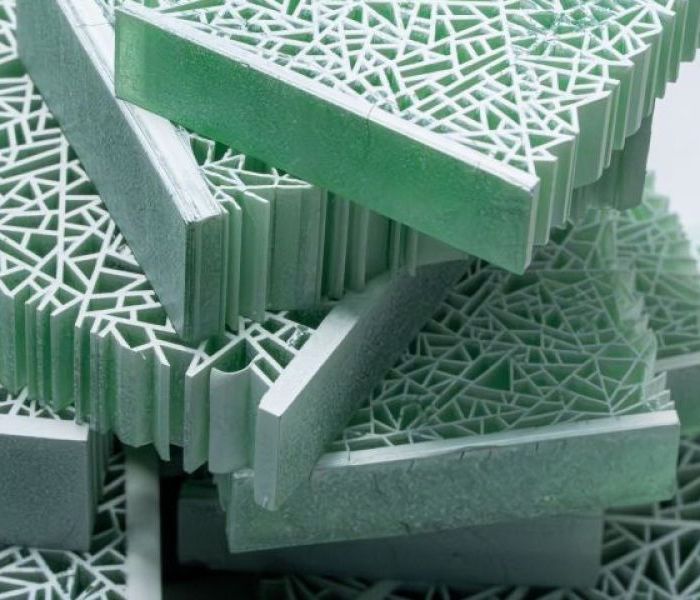
Most reinforced-concrete beams have relatively simple rectangular cross-sections. Their shape makes formwork easy to assemble, repeat and remove. But the stresses inside a beam are not distributed uniformly. Some regions need substantial material to resist forces while others contribute less to carrying the load. Engineers can use computational methods to map those forces and propose shapes that concentrate material where it is needed. The resulting designs can be curved, branched or unusually thin in places. A rigid mold for such a component can be expensive to machine, and a specialised concrete printer may not be available to an ordinary contractor. MIT’s research addresses this gap between computational design and accessible construction.
How the fabric formwork works
The team translated a three-dimensional beam design into patterns for flat pieces of cotton fabric. Those pieces were cut and sewn together, then attached to a simple timber support frame. When concrete was poured into the flexible enclosure, the textile stretched and settled under the material’s weight. That movement is normally a source of uncertainty: a fabric mold does not hold its shape like a rigid box. The researchers therefore used computational pattern design to anticipate deformation before the pour. In effect, they designed the fabric’s starting shape around the way it would behave under pressure. This is the key manufacturing insight, not simply the substitution of fabric for wood.
Two design methods working together
The research combines graphic statics with topology optimization. Graphic statics helps engineers arrange structural forces and reinforcement in a form that is understandable and relatively quick to calculate. Topology optimization identifies where material is most useful and where it can be reduced while meeting the design constraints. Each method solves a different part of the problem. The researchers first determined a practical route for steel reinforcement, then shaped the surrounding concrete to carry forces efficiently. That order of operations matters because a mathematically elegant beam is not necessarily buildable. Reinforcing bars still need to be bent, positioned and secured, and concrete must flow through the available spaces without leaving voids.
Why the concrete mix mattered
The team had to adapt its concrete mix to the narrow passages and absorbent formwork. A very fluid mixture could leak water through the woven cotton and push the fabric away from its intended geometry. A mixture with large aggregate could jam in the beam’s slender sections. The researchers used a moderately wet, sand-rich mix containing small stones. They placed and compacted it manually, working through the fabric from the outside. The material’s flexibility helped them reach areas that would have been difficult to consolidate in a rigid mold without specialised vibration equipment. That does not mean fabric formwork removes all quality-control challenges. Concrete consistency, placement technique and curing remain important variables.
Testing the shapes
The researchers made three fabric molds for the same beam geometry, using 36, 56 and 76 fabric pieces. The comparison tested whether adding seams improved accuracy. More pieces allowed finer local control but also introduced more cutting, alignment and sewing opportunities for error. The 56-piece version offered the best balance in the team’s assessment. This finding is useful because it warns against assuming that the most elaborate fabrication pattern must produce the most reliable result. Engineers often face trade-offs between theoretical precision and practical assembly. The study provides an example of measuring those trade-offs rather than choosing the most complex solution by default.
What the load test established
The team placed 36 water-filled buckets on one beam, reaching approximately 30 percent of its design load to represent ordinary service conditions. They measured how far the beam deflected as weight was added and removed. At the centre, the observed movement was within about two percent of the computer model’s prediction. That agreement is encouraging because it suggests the design process captured the beam’s behaviour under the tested conditions. It is not the same as demonstrating performance at ultimate failure, over decades of use or in every environmental condition. The researchers identify further testing to failure as a next step. Those limits should accompany any discussion of the promising numerical result.
The material savings in context
The headline comparison, one-third as much concrete and half as much steel, reflects a specific optimised beam against a conventional beam designed for the same loading requirement. Material savings of that magnitude could matter because cement production is a substantial source of greenhouse-gas emissions. Reducing the amount of concrete used can lower the demand for cement, although the actual carbon benefit depends on mix composition, reinforcement, transport and construction processes. The study does not establish a universal lifecycle emissions figure for every fabric-formed beam. A rigorous environmental comparison would account for the full supply chain and the performance of the structure over its intended service life.
The economics vary by region
One of the most important findings is that the cheaper design depends on where it is made. MIT reports that in the Global South, where material costs can be high relative to labour, the fabric versions in its comparison were approximately 10 to 20 percent less expensive than conventional formwork. In the Global North, higher sewing labour costs made the fabric options about 16 to 55 percent more expensive. These are study estimates for particular conditions, not universal market quotations. They demonstrate why a technique can be technically effective yet commercially attractive only in some settings. Future adoption will depend on local wages, material prices, production volumes and the availability of skilled fabrication.
Where the approach might fit
Fabric formwork could be particularly interesting for bespoke beams, pedestrian structures, roof framing and architectural components where unusual shapes offer both structural and visual advantages. It is less obviously suitable for projects that repeat the same rectangular beam hundreds of times. In those cases, a reusable rigid mold can spread its cost across many pours. The technology’s appeal is therefore not that fabric will replace every traditional mold. It is that engineers may have a lower-cost way to realise custom shapes that would otherwise require robotic fabrication or expensive machining. Contractors would still need reliable specifications, inspection methods and approval from relevant building authorities before adopting a new structural system.
Scaling beyond a laboratory beam
The demonstration beam was three metres long, substantially larger than an earlier version made by the team. But scaling up changes the engineering problem. A longer beam weighs more, its wet concrete creates different pressures on the mold, and the structural demands may be greater. A design that performs well at three metres cannot simply be stretched without new calculations and tests. Practical deployment would also need consistent workmanship, durability data and construction-site procedures that account for weather and handling. Researchers plan to test multiple beams to failure. That work will be important for understanding safety margins, variability between specimens and whether the approach can satisfy real-world design requirements.
What the research changes
The strongest conclusion is that accessible textile fabrication can help bridge the divide between sophisticated structural optimization and the realities of construction. The researchers have shown a viable proof of concept with substantial material reductions, a manageable mold-making process and a measured service-load response close to their model. They have not yet proved that the system is ready for widespread commercial use. For builders, designers and policymakers interested in lowering construction’s environmental impact, the result offers a practical direction worth following. Its future will depend on repeatable performance, honest cost comparisons and safety evidence rather than attractive shapes alone.
Frequently asked questions
Did the MIT beam use two-thirds less concrete?
In the reported comparison with a conventional beam designed for the same load, the optimized test beam used about one-third as much concrete.
Is fabric formwork cheaper everywhere?
No. MIT’s cost comparison found savings in the Global South but higher costs in the Global North, mainly because of differences in labour costs.
Can these beams be installed in buildings now?
The research is a proof of concept. Further testing, including failure tests and applicable structural approvals, would be needed before routine use.
Primary source: MIT News, November 6, 2026.