A new class of engineered materials is challenging a long-standing design habit: building structures from repeating cells that are almost identical. Researchers have created “scale-rich” metamaterials whose internal beams vary in length, thickness and connectivity, borrowing a principle seen in biological networks such as veins and webs. In a study published in Nature on November 11 and highlighted by the U.S. National Science Foundation the following day, the team reported a broader range of mechanical behaviour and improved resistance to impact in experiments. The work is early-stage, but it offers a new design route for protective equipment and lightweight structures.
Why repeating structures have limits
Many engineered metamaterials are built from repeating unit cells. A designer chooses a geometry, repeats it across a component and adjusts the material or the dimensions to achieve a target response. This approach can produce strong, lightweight and predictable structures. But the repeated pattern can also create a weakness: if one region buckles or breaks, the same geometry may encourage stress to concentrate in neighbouring regions.
The new work starts from a different observation. Natural networks often contain connections with a wide range of lengths, thicknesses and degrees of connectivity. A leaf vein system, for example, does not consist of identical pipes repeated at regular intervals. Those differences can help distribute loads and maintain function when part of a network is damaged. The researchers asked whether a similar principle could be built into an engineered material.
What makes a metamaterial scale-rich
The term scale-rich describes an architecture in which the internal beams or ligaments vary across multiple length scales. Instead of a single repeated cell size, the structure contains a broad distribution of beam lengths, thicknesses and connections. The design is not random in the sense of being uncontrolled: an algorithm generates the network and lets researchers adjust parameters that shape its density and mechanical response.
The study’s framework uses a process that adds ligaments to a domain in stages. New elements grow from selected points and stop when they intersect existing elements or reach a boundary. As the process continues, the structure develops a connected network with features that span a range of scales. This allows the researchers to tune the architecture without relying on one uniform building block.
How the team tested the design
The research combined computational modelling with physical experiments. The team compared scale-rich structures with conventional reference architectures, including square and hexagonal lattices and a Voronoi-based structure. The researchers fabricated centimetre-scale samples using vat photopolymerisation and also explored much smaller features using two-photon lithography. The goal was to test whether the proposed network could be manufactured and whether its predicted behaviour appeared in real specimens.
The results showed that the network could combine properties that are difficult to obtain together in more uniform designs. It could be tuned to show different directional stiffness, meaning the material could resist force differently depending on the direction in which it was loaded. It also showed more distributed deformation under compression rather than allowing a narrow region to collapse and carry most of the strain.
The significance of the reported 190-fold range
The paper reports a 190-fold tunable range of elastic anisotropy across the investigated designs and densities. Anisotropy means that a material’s response depends on direction. In conventional engineering, anisotropy can be a limitation if a component must behave uniformly. But in a designed structure it can be useful: a panel may need to be stiff in one direction, flexible in another or guide waves along a chosen path.
The key is control. A broad range of directional stiffness can help designers tailor a component to the load it is expected to face. The study’s framework is not a claim that one material will automatically become 190 times stronger in every direction. It describes a range of tunable responses across different network configurations. The distinction matters when translating research results into engineering specifications.
How the structures handle impact
The researchers also examined nonlinear deformation and energy absorption. Under compression, conventional structures can develop localised bands where material cells compact and neighbouring regions carry a disproportionate share of the load. The scale-rich architecture showed more delocalised deformation, spreading the change across a wider area. This behaviour can help prevent a single weak region from becoming the point at which the entire structure fails.
The paper also reports a simulation in which the stress experienced by a protected payload was reduced by up to 4.9 times compared with selected reference designs at the same macroscopic strain. That is a model result, not a certified impact rating for a helmet or vehicle component. It nevertheless suggests that network geometry can influence how forces travel through a protective structure and how much stress reaches something placed inside it.
Why protective equipment is an obvious application
Helmets, packaging, body armour and transport structures all face a similar challenge: absorb energy while limiting the force transmitted to a person or object. A material that spreads deformation rather than concentrating it could be useful in these settings. The NSF highlighted protective equipment, packaging and armour as possible application areas, alongside materials designed to control sound and vibration.
The most promising applications may be those where the load direction and the space available for a structure are known in advance. A helmet liner, for example, must balance energy absorption, weight, comfort, ventilation and repeat impacts. A protective package must cope with a defined range of drop and vibration conditions. A scale-rich architecture could become one design option among several, but it would still need testing against relevant safety standards and real-world loading patterns.
Beyond impact protection
The researchers also discuss the possibility of controlling elastic waves through the structure. Mechanical waves travel through materials as vibrations, and their speed and direction depend on the architecture. A network with different connection lengths and orientations could be designed to guide or redirect those waves. This opens a route toward components that do more than support a load: they could also manage vibration or shape how mechanical energy moves through a system.
Such capabilities could matter in precision equipment, aerospace structures, industrial machinery and devices that must isolate sensitive components from vibration. But those are future possibilities, not products announced by the study. Each use would require its own design process, materials testing, durability assessment and manufacturing validation. The benefit of the research is that it gives engineers a more flexible framework for exploring those requirements.
What still needs to be proved
The first prototypes are research specimens, not finished industrial components. Manufacturing resolution, material fatigue, temperature sensitivity, long-term stability, repeatability and cost all matter when a material moves from a laboratory to a factory. A design that performs well in a controlled compression test may behave differently under repeated impacts, moisture, heat, ultraviolet exposure or complex multi-directional loads.
The team’s framework also needs to be evaluated for large-scale manufacturing. A network that is easy to create with a 3D printer may be harder to produce at high volume or at the dimensions needed for a vehicle or building. Engineers will need to establish whether the performance gains justify the additional design and production complexity, and whether the geometry can be inspected and quality-controlled reliably.
Why the research matters for engineering design
The larger contribution is a shift in how engineers think about internal structure. Rather than choosing a single cell and repeating it, designers may be able to specify distributions of lengths, thicknesses and connections that generate a desired response. That approach links material science with network science, computational design and advanced manufacturing.
The idea also encourages more purposeful use of disorder. In engineering, disorder is often treated as a manufacturing defect or an unwanted source of variability. Here, controlled variation is a design feature. The challenge is to distinguish useful heterogeneity from uncontrolled defects and to build models that can predict the difference. If that can be done, scale-rich architectures could become part of a wider toolkit for designing structures that are lighter, more resilient and more adaptable.
| Design feature | Potential engineering effect | Evidence stage |
|---|---|---|
| Variable beam lengths and thicknesses | Multiple structural scales within one network | Modelled and fabricated |
| Tunable anisotropy | Directional stiffness can be designed | Simulation and experiments |
| Distributed deformation | Less concentrated collapse under selected loads | Experimental comparison |
| Payload stress reduction | Potentially improved impact protection | Reported simulation result |
Frequently asked questions
What is a scale-rich metamaterial?
It is an engineered structure whose internal beams vary across a broad range of lengths, thicknesses and connections rather than repeating one identical unit cell.
Does the new material make helmets or armour ready for use?
No. The research provides a design framework and laboratory-scale evidence. Products would still need manufacturing development, durability testing and certification against relevant safety standards.
Why is controlled disorder useful?
Variation in the internal network can spread deformation and tune directional stiffness, potentially reducing the concentration of stress in one small region.
Sources and further reading
- Nature: Scale-rich network-based metamaterials, published 11 November 2026
- U.S. National Science Foundation: Nature-inspired design yields new class of metamaterials, 12 November 2026
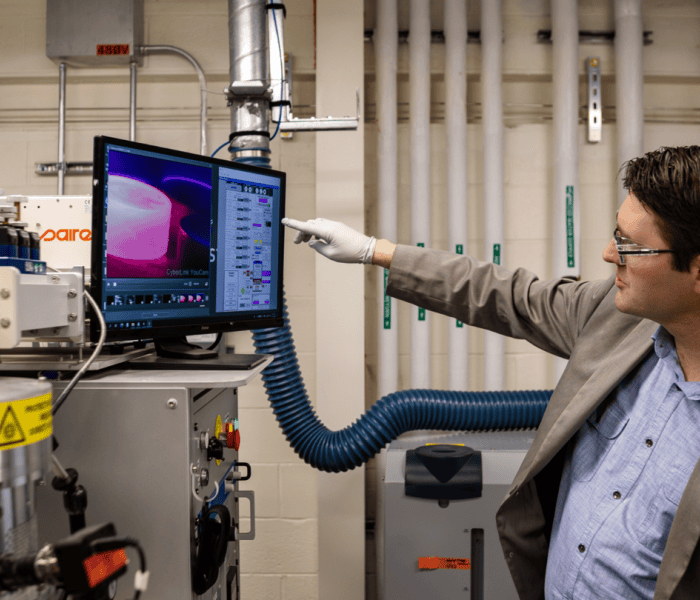
Featured image credit: Rishi Kommalapati / U.S. National Science Foundation; polymeric scale-rich metamaterial samples used for mechanical characterisation.