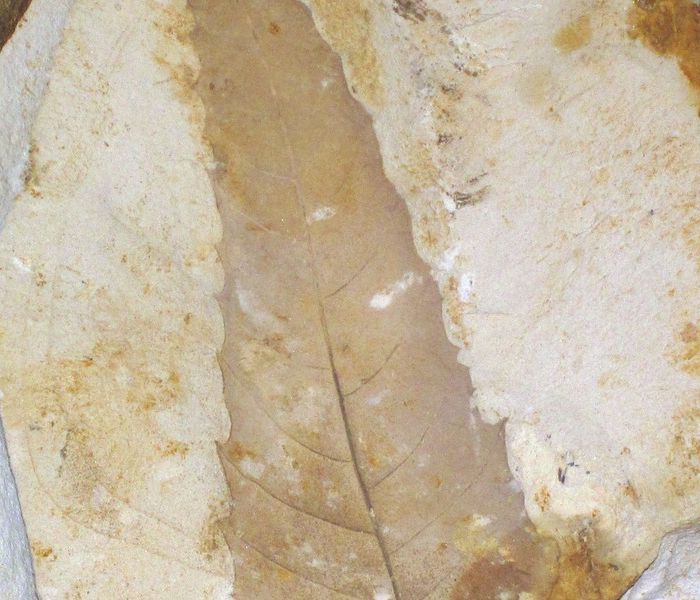
A new analysis of the Radoboj deposit finds signs of mild winters and diverse plant–insect interactions on an island in a sea that once covered much of Central and Southern Europe.
A fossil deposit in northern Croatia holds evidence that a subtropical island retained mild winters after a major episode of global cooling. In a study published on 28 November in Communications Earth & Environment, researchers re-examined plants and traces of insect feeding from Radoboj, where marine sediments also preserved the remains of fish, dolphins and birds. They reconstructed conditions on land about 12.7 million to 12.1 million years ago, when the coastline of Europe looked very different from today’s.
The findings show why a global temperature trend tells only part of the story about where particular plants and animals could live. Radoboj’s fossil leaves point to warmth after the Middle Miocene Climate Transition, a cooling around 14 million to 13 million years ago. The study’s explanation points to the geography of the Central Paratethys, the sea that then extended across much of Central and Southern Europe, and the influence of the surrounding water on local conditions.
A record assembled on the seabed
The fossils come from a deposit with unusually rich preservation. Radoboj has yielded terrestrial leaves and insects alongside remains of organisms that lived in water. The mix reflects where the remains accumulated. Leaves and insects could have moved from land into the sea by wind, runoff or coastal currents. An inventory of the marine sediments therefore captures a mixture of organisms from the surrounding landscape and waters. The task is to work out which parts of that mixture describe the vegetation closest to the deposit.
The research team, led by Thomas Denk, examined the characteristics and variety of the fossil plants and considered how the remains could have reached the seabed. The researchers point to the presence of large leaves, delicate reproductive structures and terrestrial insects as evidence for a substantial nearby source. A few small leaves associated with cooler settings and other material suited to dispersal could have travelled farther. In their reading, the dominance of warmth-associated plants is difficult to explain as a result of long-distance transport alone.
The plants also suggest a varied landscape. The researchers considered coastal vegetation that included palms, broadleaf evergreen communities and settings where soils or exposure would have favoured plants adapted to drier conditions. Because the remains came together in marine sediment, the fossils give a composite view of the surrounding vegetation. They can reveal the presence of different habitats even where researchers lack the evidence to assign each kind of leaf to a specific patch of land.
How fossil leaves can indicate climate
The study used a method that relates physical characteristics of leaf communities to climate. Researchers can compare the shape, size and edges of fossil leaves with the kinds of leaf communities found under measured modern conditions. A fossil collection with diverse leaves supplies multiple clues rather than relying on the climatic preferences of one extinct plant. The comparisons produce estimates and prediction intervals. Those intervals matter because different modern reference datasets can give different answers for the same fossil material.
Using two modern calibrations, the researchers obtained central estimates of about 19.4°C to 20.0°C for mean annual temperature and 11.5°C to 13.0°C for the mean temperature of the coldest month. These are the ranges of central estimates between the two calibrations. The associated prediction intervals are wider. Estimates from the two calibrations were closer for temperatures than for the amount of precipitation over the three driest months, which differed substantially. This gives stronger grounds for an interpretation of mild winters than for a precise description of rainfall or its seasonality.
The paper puts those estimates alongside studies of other fossil sites. Some other European deposits of broadly comparable age have published coldest-month estimates markedly below those inferred for Radoboj. The comparison depends on the quality of the underlying assemblages and methods, but it makes the local warmth more informative than a temperature estimate in isolation. If deposits from the same broad interval represent substantially different settings, mapping those differences helps explain where warmth-associated vegetation could flourish after the global cooling.
The deposits also carry clues to the relationships between plants and insects. Damage left on a fossil leaf can preserve signs of interactions even where the individual insect is absent. Researchers can compare the variety of damage across collections. A site with more specimens has more opportunities to reveal rare forms, so the study used a standardisation procedure to account for differences in sampling. On that comparison, the Radoboj assemblage had more distinct damage types than the other European Cenozoic assemblages assessed. The result concerns the variety of traces and cannot be read as a direct census of all the insects that lived on the island.
What a warm inland sea can explain
An island’s air temperatures can differ from those of the nearby mainland because water exchanges heat with the atmosphere over a longer period than the land surface does. A warm body of water can help moderate winter cooling along a coast. That provides a physical explanation the researchers can compare with the biological record. The warm regional conditions inferred from leaf traits, the presence of marine material and the evidence for nearby subtropical vegetation are consistent with a maritime setting. The data allow other aspects of that setting, including precise rainfall patterns, to remain uncertain.
Geography also matters when fossil sites are used to compare changes across broad regions. Two collections can be similar in age and still represent different coastlines, elevations or degrees of exposure to water. If those differences are overlooked, the survival of warm-climate plants in one place might be taken as evidence for a wider temperature trend. The Radoboj deposit gives researchers a reason to ask more specifically where plants lived, how conditions differed from nearby sites and which effects of global climate change a particular record can resolve.
The result is also a reminder that one cooling event may leave geographically uneven signatures. A global estimate averages over places that behaved differently. On land, mild winters can influence which vegetation can persist even when changes elsewhere are substantial. The researchers argue that the arrangement of land and water helps account for the warmth recorded at Radoboj. The exact scale of the island environment and the extent of the comparable coastal vegetation are questions other deposits can help address.
What researchers can test next
The Natural History Museum of Slovenia has traced its collection of Radoboj material to nineteenth-century collecting. Collections like this can support questions that the original collectors had no means to answer. Their research value also depends on how well the specimens’ origins are documented, since leaves from different beds may record different points in the history of the sea.
The most direct comparison would come from tracing the same kinds of fossils and leaf damage through additional deposits of comparable age, with careful attention to where the remains accumulated. An inland site could supply a check on temperature differences. Another island or coastal site could help establish how widespread the winter warmth was. Independent climate indicators in well-dated sediments would add evidence where the leaf comparisons are less precise, especially about water availability and seasonal rainfall.
The find speaks to a wider question about the fossil record. Ancient climate change altered the average conditions facing ecosystems, but local geography influenced how that pressure reached individual places. Radoboj preserves an example of warmth in a particular setting. By making the local evidence explicit, the study gives researchers a basis for comparing that setting with other parts of Europe and with marine records of the wider cooling. The next step is to test how much of the apparent contrast survives when more sites can be analysed with comparable methods and uncertainty ranges.
Frequently asked questions
How old are the Radoboj fossils?
The study places the fossil deposit at about 12.7 million to 12.1 million years old, within the Middle Miocene.
How do researchers infer temperature from fossil leaves?
They compare physical characteristics across the fossil leaf community with characteristics of modern leaf communities from places with measured climates.
What can the fossil deposit tell us about rainfall?
The researchers found less agreement on dry-season rainfall than on temperature. The evidence for mild winters is stronger than the evidence for a precise rainfall pattern.
Sources and further reading
- Communications Earth & Environment paper and methods for the Radoboj reconstruction
- Natural History Museum of Slovenia on the history and contents of the Radoboj collection
- Climate Leaf Analysis Multivariate Program and the basis of leaf climate estimates
- Featured photograph by Wlodzimierz. Public domain dedication by the photographer. Cropped.