The WHO region reported 96% first-dose coverage in 2025, yet about 1.1 million infants missed that dose. A new regional assessment calls for more precise use of local health records.
A regional warning behind a high coverage figure
The World Health Organization urged countries in its South-East Asia Region on 28 November to identify local gaps in measles vaccination more precisely. The agency’s regional update estimated that 4.6 million cases and 16,800 deaths occurred in the region in 2025. That accounted for about 47% of cases worldwide even though WHO said the region had the highest measles vaccination coverage among its regions. It reported that approximately 1.1 million infants in the region still missed a first dose.
The regional office put coverage at 96% for the first vaccine dose and 93% for the second. Those averages describe substantial reach across a large population. They also leave room for significant local differences, particularly where children with missed doses live close to one another. The new assessment gives public health teams a practical focus. WHO is asking them to look below national averages, to use district data to find missed children, and to consider older age groups in which vaccination gaps may have persisted for years.
The update builds on WHO’s global report released on 27 November. That report estimated a historic low in measles deaths worldwide and documented sizable gaps in vaccination. The regional update goes further into the South-East Asia figures. It identifies which parts of routine immunisation and surveillance need attention if countries are to turn a long-term decline in illness into sustained interruption of local transmission.
Why 96% coverage can still leave districts vulnerable
A regional coverage estimate combines data from places with different population sizes and different health systems. A large population that receives vaccination at high rates can raise the combined estimate. A cluster of districts in which children repeatedly miss vaccination can still support outbreaks. The average does not tell a health worker which neighbourhoods, schools or villages contain children who missed their first or second opportunity.
The number of missed infants and the share of children vaccinated answer related questions. A small fraction of a very large population can represent a large number of people. It also matters how missed doses are distributed. If the same areas are missed repeatedly, susceptible children from several years can live in close proximity. That is one reason WHO called for district-level records and for catch-up work directed at the communities those records identify.
First- and second-dose figures also reveal different barriers. Some children have never had access to a measles-containing vaccine. Others enter a programme and do not return for the later dose. A clinic might find that restoring regular sessions helps with one problem while checking follow-up records addresses another. A regional total provides an estimate of the overall scale. Local data can help identify why the gap exists and what might close it.
What the update adds for India
India launched a national measles and rubella elimination campaign in April 2025, with the goal of eliminating both diseases by 2026. The target is distinct from the regional WHO case estimate, which concerns measles. India’s administrative figures in WHO’s immunisation data portal put its first-dose measles coverage at 98.26% for 2025. That number describes doses reported through one administrative measure. It should be read alongside data about who received the second dose, how vaccination varies across districts and how effectively illness is being detected.
The Indian Express reported on 28 November that WHO experts considered India unlikely to meet the regional elimination target by the end of 2026 despite progress in immunisation. The point is more specific than a statement about coverage alone. Verifying elimination depends on evidence that sustained local transmission has been interrupted and that surveillance is good enough to identify infections when they occur. A campaign headline or high coverage figure therefore cannot substitute for records of transmission and investigation.
The national campaign already identified routine delivery of two doses as a priority. The regional update adds emphasis on finding people who missed earlier opportunities. For a country as large as India, a district’s task may be as specific as checking why a particular group of children failed to return for a second appointment. Other districts may need to improve access to services in the first place. Reporting both the national progress and the local obstacles makes it possible to assess where the campaign is still falling short.
Why older children and surveillance matter
WHO said immunity gaps from childhood can persist into older age groups. If several groups of children missed vaccinations over time, service records for the youngest children provide only part of the picture. The agency called for attention to older children and adolescents and said that identifying susceptible adults would become increasingly important as countries approach elimination. The choice of which groups to prioritise depends on local evidence and national guidance.
Surveillance supplies information that coverage records alone cannot. Investigating suspected cases and confirming them through laboratory testing helps public health teams distinguish measles from other illnesses. The regional office also called for timely investigation and response when outbreaks occur. A system that reports few infections may reflect low transmission, while the quality of investigation determines how much confidence that observation can carry.
Public reporting also has to distinguish estimated burden from detected cases. The 4.6 million figure is WHO’s estimate of cases in 2025, based on the agency’s assessment of the disease burden. It is not a tally of every patient entered into a single reporting system. Where case detection improves, reports may identify infections that would previously have gone uncounted. This makes surveillance quality and the method used to produce an estimate important context when comparing years or countries.
The distinction matters at district level as well. A high administrative coverage percentage relies on the numbers of doses reported and the estimate of children who should have received them. Population movement can make it difficult to keep both parts of that calculation accurate. A clinic may be doing reliable work while missing families who recently moved into its area. Reviewing coverage together with local case investigations lets a health team check whether areas with reassuring averages are also meeting their goals in practice.
The regional assessment’s message on older groups also has a planning implication. Routine vaccination schedules will reach children who present for their appointments, while records spanning several years can highlight groups that missed earlier rounds. An outbreak can expose gaps that were not apparent from the latest annual coverage tables. WHO’s call to look at older groups asks countries to use that longer history when deciding where to concentrate follow-up.
The measures that will show whether the gaps are closing
WHO says regional measles cases have fallen 59% and deaths 90% since 2000. By the end of 2025, Bhutan, Maldives, the Democratic People’s Republic of Korea and Timor-Leste had been verified as having eliminated measles, according to the regional office. That progress shows what countries in the region have already achieved. The continued report of outbreaks in 2026 shows why the agency is asking governments to keep tracking transmission, including where coverage looks reassuring.
The next useful figures will include district-level first- and second-dose coverage and evidence of whether catch-up work is reaching children who missed routine services. A stronger picture of outbreak investigations will help readers interpret a rise or fall in detected cases. For India in particular, the evidence relevant to the 2026 goal will include how transmission has been interrupted, which districts still report cases and what the country can show about the sensitivity of its surveillance.
Frequently asked questions
How many measles cases did WHO estimate in the region?
The WHO South-East Asia Region accounted for an estimated 4.6 million cases in 2025, about 47% of the worldwide estimate.
How can coverage be high while outbreaks continue?
National and regional averages can conceal communities where many children missed doses. Local coverage and surveillance help identify those gaps.
What does measles elimination mean?
It refers to verified interruption of sustained local transmission in a defined area. Continued surveillance and vaccination help prevent transmission from becoming established again.
Sources and further reading
- WHO South-East Asia regional assessment on 28 November
- WHO immunisation data portal for India
- The Indian Express reporting on India’s elimination target
- India’s announcement of the national elimination campaign
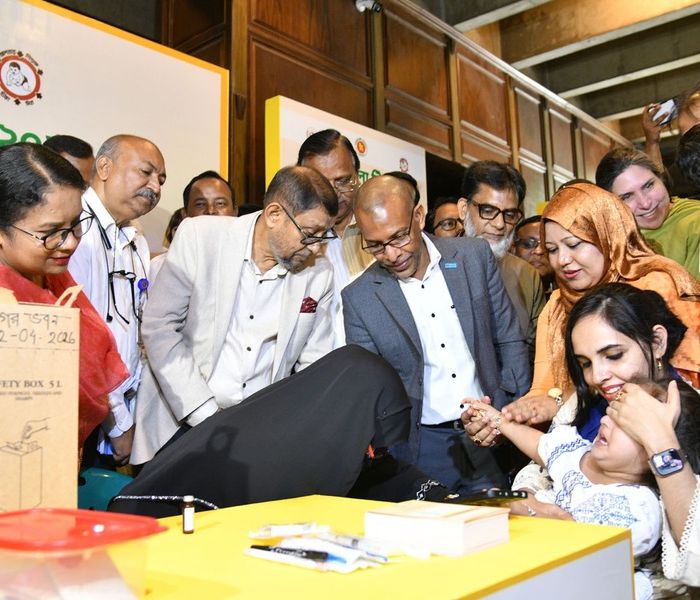
- Featured photograph by Bangladesh Press Information Department. Public domain under the department’s published media-use policy. Cropped.