Computer simulations suggest that the tiny asteroid 1998 KY26 may be too warm to retain the ice needed for a proposed dark-comet explanation of its unusual motion, raising new questions ahead of a planned 2031 spacecraft encounter.
A small asteroid with a puzzling motion
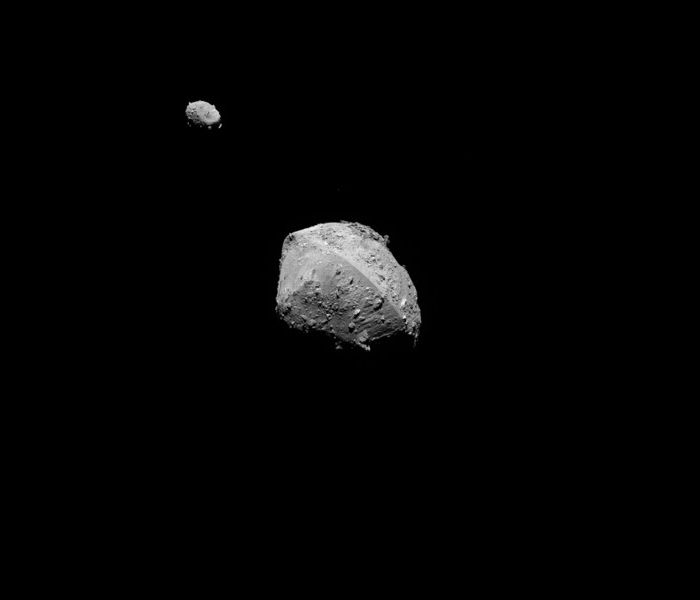
Asteroid 1998 KY26 is a near-Earth object scheduled for a visit by Japan’s Hayabusa2 spacecraft in 2031. Astronomers have noticed that its motion is not fully explained by the simplest gravitational description. Small nongravitational accelerations can arise from several physical effects, including thermal radiation and the release of material. Some earlier interpretations considered whether escaping water vapour could be pushing the asteroid in a comet-like fashion. A new simulation study reported November 10 challenges that possibility by examining whether water ice could survive within the body.
What scientists mean by dark comet
A conventional comet often develops a visible cloud of gas and dust as sunlight heats volatile material. A proposed dark comet, by contrast, may show nongravitational acceleration without an obvious visible coma. The label is a hypothesis about physical behaviour, not a declaration that every unusual asteroid contains ice. The idea is scientifically interesting because a very weak gas flow might alter a tiny body’s orbit without producing a conspicuous cloud. Establishing such an explanation requires evidence that volatile material exists and can escape at the necessary rate.
The new thermal investigation
Korbin Hansen and Masatoshi Hirabayashi at the Georgia Institute of Technology used computer simulations to investigate the surface and interior of 1998 KY26. Their central question was whether the object’s thermal environment could permit buried ice to remain stable over relevant timescales. A small asteroid absorbs sunlight, radiates heat and conducts some energy into its interior. The balance depends on material properties, rotation, shape and orbit. Models help researchers test plausible combinations of these factors, although a simulation cannot substitute for direct measurements of the asteroid’s actual internal composition.
Why temperature is decisive
Water ice can sublimate, changing directly from solid to gas under low-pressure conditions. If ice survives below the surface, solar heating might drive vapour through pores or fractures and produce a weak thrust. But if the asteroid’s interior becomes too warm over time, its ice reservoir could disappear before the present era. The new modelling indicates that 1998 KY26 is too warm to retain the ice required by the proposed explanation. This does not identify the true source of its acceleration; it removes or weakens one candidate mechanism under the model’s assumptions.
A reminder about model assumptions
Thermal simulations rely on estimates of properties that may not yet be measured precisely. These include how efficiently a surface absorbs sunlight, how quickly it radiates heat and how heat travels through rock or loose material. The body’s spin and orbital history also affect exposure. A conclusion that ice is unlikely is therefore best understood as a constraint derived from plausible physical conditions, not a direct observation of every part of the interior. Future spacecraft data could confirm the model or reveal unexpected features that require revising it.
Why small bodies are difficult to interpret
For a large planet, the gravitational forces governing motion are enormous compared with many small physical effects. For a tiny asteroid, the gentle push from sunlight or emitted heat can become measurable over time. The Yarkovsky effect, for example, arises because a rotating body emits thermal radiation unevenly. Other possibilities include surface activity or changes in observational estimates. Identifying the right cause requires precise orbital tracking and a realistic model of the object’s size, shape and thermal properties. An unexplained acceleration is a clue, not proof of cometary activity.
The role of Hayabusa2
Japan’s Hayabusa2 mission is best known for collecting samples from asteroid Ryugu and returning them to Earth. Its extended mission includes an encounter with 1998 KY26 in 2031. Visiting the object can provide measurements unavailable from distant telescopes, including detailed images and information about its shape, rotation and surface properties. Those observations could improve estimates of thermal behaviour and orbital forces. The planned encounter is not a promise that the spacecraft will discover ice, and it should not be described as a sample-return mission from this target.
Why 2031 is an important date
A spacecraft encounter offers a chance to compare competing explanations against new evidence. Researchers can make predictions now about what the surface and physical environment should look like if particular models are correct. When Hayabusa2 arrives, those predictions can be tested. The time between the new simulations and the encounter is useful for refining models and planning observations. The target date remains a mission plan, and the spacecraft must continue operating successfully to complete the encounter. The current research is significant precisely because it shapes questions that can later be investigated directly.
How asteroid surfaces evolve
Small bodies can undergo heating, cooling, impacts, rotation changes and the movement of loose material. These processes affect whether volatile substances survive and how thermal radiation acts on the surface. A body that once contained ice may no longer retain it, while a dry surface can still experience measurable nongravitational forces. Scientists therefore distinguish an object’s present physical state from hypotheses about its formation and earlier history. The new study addresses present-day ice survival under simulated conditions rather than providing a complete biography of 1998 KY26.
The difference between observation and interpretation
The observed orbital behaviour motivates the research, while the dark-comet explanation is an interpretation of that behaviour. The simulation is a test of the interpretation. This chain of reasoning is central to astronomy, where scientists frequently study objects too distant or small to sample directly. A model can show that a proposed mechanism is inconsistent with known constraints without immediately revealing the correct alternative. That is still progress: it narrows the range of possibilities and helps observers decide which measurements will be most informative.
What the findings do not prove
The new study does not show that dark comets cannot exist, nor does it rule out volatile-driven motion for every other small body. It concerns a particular asteroid under a particular set of modelled conditions. It also does not establish that 1998 KY26 poses an imminent danger to Earth. Its designation as a near-Earth asteroid describes an orbital category, not a forecast of impact. Reports should avoid turning a debate about thermal physics into an unsupported claim about planetary risk or a definitive conclusion about the composition of all asteroids.
What comes next
Astronomers can refine the object’s orbit, rotation and thermal characteristics through additional observations before Hayabusa2’s planned arrival. The spacecraft encounter could then supply constraints on shape, surface texture and other physical properties. Those data may help identify whether thermal forces or another mechanism explain the acceleration. For now, the main finding is a scientifically meaningful challenge to the water-ice hypothesis. The broader lesson is that unusual motion demands multiple tests, and a compelling nickname such as dark comet should never outrun the evidence.
Frequently asked questions
What is a dark comet?
A proposed small body showing comet-like nongravitational motion without an obvious visible coma.
When will Hayabusa2 visit 1998 KY26?
The spacecraft encounter is planned for 2031.
Did the simulations directly inspect the asteroid?
No. They modelled thermal conditions; direct spacecraft observations are still ahead.
Source: Research coverage published November 10, 2026. Featured photograph is illustrative.