ESA says its Hera spacecraft is arriving at the Didymos-Dimorphos asteroid system during November 2026 to study the aftermath of NASA’s 2022 DART impact and improve planetary-defence models.
A follow-up to a historic collision
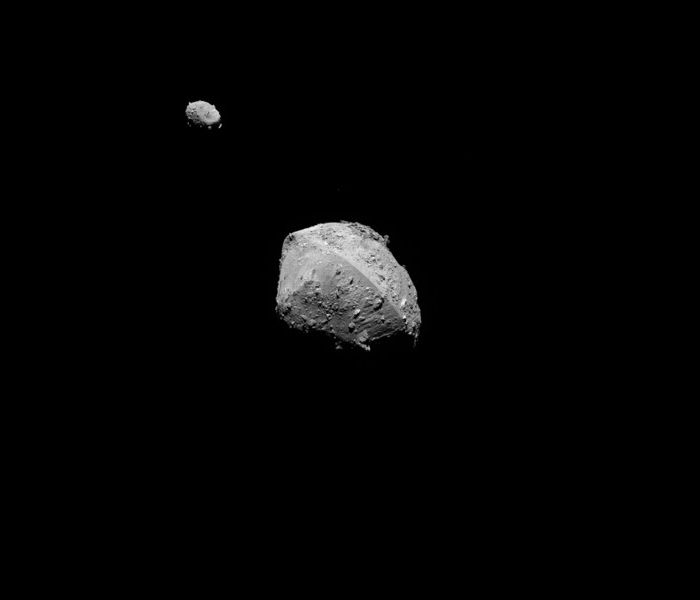
The European Space Agency’s Hera mission is approaching Dimorphos, the small asteroid whose orbit NASA’s DART spacecraft changed in September 2022. ESA says the arrival takes place during November 2026. The objective is to investigate what the impact did to the asteroid and refine the science of kinetic-impact deflection.
Readers should separate the immediate observation from broader interpretations. The evidence described here comes from a dated report or research statement, while the wider consequences depend on decisions and measurements that may not yet exist. A strong conclusion requires showing how an event fits within a longer sequence and identifying the assumptions that could change the assessment. This is particularly important when a story attracts attention because its implications seem dramatic.
The two-asteroid system
Dimorphos is approximately 151 metres across and orbits Didymos, a parent asteroid roughly 780 metres in diameter, according to ESA. The pair provides a natural laboratory for studying how a collision changes an asteroid’s motion. Neither asteroid was on a collision course with Earth during the DART test.
One useful way to assess the development is to ask what changed today, what was already known and what remains uncertain. That distinction prevents a newly published explanation from being mistaken for a newly occurring event. It also makes the reporting more useful to readers who want context rather than only a headline. Independent records, transparent methodology and follow-up evidence are more reliable than confident predictions made before the relevant facts are available.
What DART demonstrated
NASA deliberately crashed DART into Dimorphos on September 26, 2022, changing its orbital period. Observations from Earth established that the kinetic impact altered its motion. The exact physical changes to Dimorphos remain an important question that Hera is designed to investigate.
The practical importance of this point is that complex systems rarely respond to one factor in isolation. Political institutions, scientific experiments and technical operations all depend on multiple interacting conditions. Changing one variable can produce unexpected results elsewhere. Researchers and decision-makers therefore compare alternatives, monitor consequences and revise their expectations as evidence accumulates. Acknowledging those constraints is not a sign of weakness; it is part of responsible analysis.
Why close-up inspection matters
Telescopes can measure changes in brightness and orbit, but they cannot resolve every feature of a small distant asteroid. Hera’s close approach can provide images and measurements that reveal shape, surface structure and the impact region. Those details help scientists interpret the earlier experiment.
Interpretation also depends on scale. An observation at one site, in one experiment or during one meeting may not generalise to every situation. Similarly, a reported national figure may hide differences between regions or groups. Readers should check what population, location and time period the evidence actually covers. That helps prevent a narrow finding from being presented as a universal rule and makes future comparisons more meaningful.
The importance of asteroid composition
A solid rocky body can respond differently to impact than a loose aggregate of rubble. Internal structure influences how energy and momentum are transferred. Hera’s observations can help constrain models that otherwise rely on assumptions about material properties.
The most informative follow-up will come from specific, checkable developments rather than repetition of initial claims. New measurements, official documents, independent replication or completed negotiations can strengthen or revise the original account. Until that happens, the boundaries of the available evidence should remain visible. This approach also protects against misinformation, which often spreads by removing the qualifications that accompany an authentic report.
A crater or something stranger
Scientists want to know whether DART produced a recognisable crater, reshaped Dimorphos or redistributed large amounts of material. The answer affects how the impact’s effectiveness is calculated. ESA has stressed that the physical aftermath is not yet fully known.
Finally, the significance of a development is not measured solely by how surprising it sounds. Its lasting value depends on whether it changes understanding, enables practical action or alters the choices facing institutions and communities. Some breakthroughs take years to translate into applications, while some diplomatic announcements have little immediate effect. Tracking outcomes over time is the best way to distinguish genuine progress from momentary attention.
Momentum from flying debris
When material is ejected after an impact, its recoil can add momentum to the target. Understanding that effect is important because it may amplify or complicate a deflection. Hera’s data can help researchers evaluate how much the ejecta contributed to the orbital change.
Readers should separate the immediate observation from broader interpretations. The evidence described here comes from a dated report or research statement, while the wider consequences depend on decisions and measurements that may not yet exist. A strong conclusion requires showing how an event fits within a longer sequence and identifying the assumptions that could change the assessment. This is particularly important when a story attracts attention because its implications seem dramatic.
The role of gravity
Dimorphos moves within the gravitational influence of Didymos. Changes to shape, rotation and surface material can affect the system’s dynamics. Detailed observations will help connect local physical processes to the orbital measurements already obtained from Earth.
One useful way to assess the development is to ask what changed today, what was already known and what remains uncertain. That distinction prevents a newly published explanation from being mistaken for a newly occurring event. It also makes the reporting more useful to readers who want context rather than only a headline. Independent records, transparent methodology and follow-up evidence are more reliable than confident predictions made before the relevant facts are available.
Why the mission is planetary defence
A future hazardous asteroid might be detected years before a potential impact. A small, well-timed change in its trajectory could prevent a collision. The DART-Hera programme aims to make predictions about such interventions more reliable, not to demonstrate that every asteroid can be deflected with the same technique.
The practical importance of this point is that complex systems rarely respond to one factor in isolation. Political institutions, scientific experiments and technical operations all depend on multiple interacting conditions. Changing one variable can produce unexpected results elsewhere. Researchers and decision-makers therefore compare alternatives, monitor consequences and revise their expectations as evidence accumulates. Acknowledging those constraints is not a sign of weakness; it is part of responsible analysis.
Ten scientific mysteries
ESA has highlighted ten questions Hera will explore, spanning asteroid shape, structure, impact effects and dynamical behaviour. Answering them will help researchers improve numerical models. The mission is also an opportunity to study how small bodies evolve through collisions.
Interpretation also depends on scale. An observation at one site, in one experiment or during one meeting may not generalise to every situation. Similarly, a reported national figure may hide differences between regions or groups. Readers should check what population, location and time period the evidence actually covers. That helps prevent a narrow finding from being presented as a universal rule and makes future comparisons more meaningful.
What is known and what remains pending
The 2022 orbital change is established; Hera’s detailed close-up findings are still emerging as the mission reaches its target. It would be premature to announce a final crater size or internal structure before the relevant observations are released and analysed.
The most informative follow-up will come from specific, checkable developments rather than repetition of initial claims. New measurements, official documents, independent replication or completed negotiations can strengthen or revise the original account. Until that happens, the boundaries of the available evidence should remain visible. This approach also protects against misinformation, which often spreads by removing the qualifications that accompany an authentic report.
The next stage of the mission
Scientists will study spacecraft data to reconstruct the impact aftermath and compare measurements with theoretical predictions. The results may influence how agencies plan future asteroid-deflection tests and surveys. The immediate significance is better evidence for a technique that could one day protect Earth.
Finally, the significance of a development is not measured solely by how surprising it sounds. Its lasting value depends on whether it changes understanding, enables practical action or alters the choices facing institutions and communities. Some breakthroughs take years to translate into applications, while some diplomatic announcements have little immediate effect. Tracking outcomes over time is the best way to distinguish genuine progress from momentary attention.
Frequently asked questions
Did DART hit Dimorphos?
Yes. NASA’s spacecraft impacted Dimorphos in September 2022 and changed its orbit.
Is Dimorphos a threat to Earth?
No. The Didymos-Dimorphos system was selected as a safe test target.
What will Hera measure?
The asteroid’s shape, surface, impact effects and other properties needed to refine deflection models.
Reporting and primary-source reference: European Space Agency. Featured image is an illustrative Unsplash photograph, not a documentary image of the event.