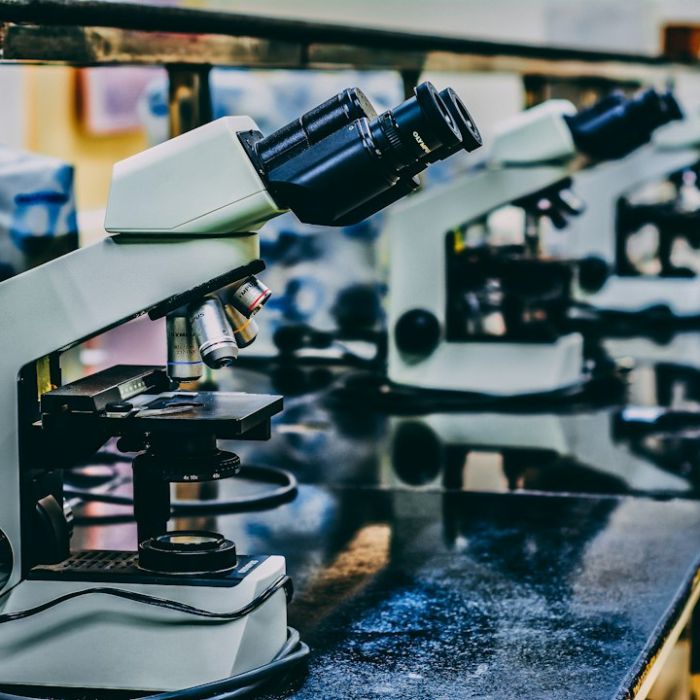
Berkeley Lab has unveiled TEM Agent, a language-driven interface for a transmission electron microscope that connects approved instrument commands with supercomputing and experiment records.
A laboratory instrument gets a conversational interface
Scientists at Lawrence Berkeley National Laboratory have developed TEM Agent, a language-model-powered assistant that can operate a transmission electron microscope through natural-language requests. Announced on October 29, the system combines existing microscope automation with a controlled interface to a powerful computing and data infrastructure. Researchers can ask it to adjust magnification, tilt a specimen, refocus or assemble a sequence of operations. The achievement is not that a chatbot has become a scientist. It is that a complicated laboratory workflow can be translated into approved instrument commands while preserving opportunities for human oversight.
Why electron microscopy is hard to operate
Transmission electron microscopes use electrons rather than visible light to study extremely small structures. They can reveal arrangements of atoms that influence how materials conduct electricity, store energy or interact with other substances. Their capabilities come with considerable complexity. Different specimens and research questions require careful choices about beam conditions, positioning and image acquisition. Visiting scientists at a shared facility may have expertise in biology or materials science without extensive training on a particular microscope. Berkeley Lab says some users need weeks of hands-on instruction for advanced techniques. That learning curve can limit access to instruments that are already expensive and heavily used.
What TEM Agent actually does
TEM Agent receives a researcher’s plain-language request and translates it into a series of predefined instrument actions. A scientist might want images at several magnifications or need to tilt a specimen and restore focus between observations. Rather than writing a custom script for each sequence, the user describes the goal and the assistant coordinates the steps. This is a different level of flexibility from a rigid automation that only repeats a fixed program. It does not mean the model can perform arbitrary physical operations or that every suggested action is scientifically appropriate. The permitted actions remain bounded by the software interface.
The role of the Model Context Protocol
The Berkeley Lab team adapted its existing automation routines to the Model Context Protocol, an open standard for connecting software systems to tools. The key design choice was to expose a fixed set of preapproved commands rather than unrestricted access to the microscope’s controls. That structure is important for equipment that can be damaged by incorrect operation or can damage a delicate sample. A language model may be good at interpreting requests, but it can also misunderstand them. Restricting its available actions helps define what it can do. Safety still depends on validation, permissions, error handling and human supervision.
A detector can generate 700 gigabytes in seconds
One detector at the Molecular Foundry can produce roughly 700 gigabytes of data in just 15 seconds, according to Berkeley Lab. That volume illustrates why instrument control and data management cannot be treated separately. Capturing a high-resolution dataset is only the beginning; scientists must store it, identify the relevant frames, process measurements and preserve the conditions under which it was acquired. A powerful microscope can produce information faster than a person can inspect it. The research challenge is therefore not only improving the image but creating a reproducible path from acquisition to analysis.
Connecting instruments to supercomputing
The system links the microscope with the National Energy Research Scientific Computing Center, known as NERSC, and a Berkeley Lab data platform called Crucible. This allows experiment information to move into a computing environment suited to demanding analysis and makes it easier to retrieve earlier settings. The laboratory reports that some experiment turnaround times can fall from hours to minutes. That is a workflow improvement reported for the demonstrated setup, not a guarantee that every microscopy task becomes equally fast. Results will depend on the type of specimen, analysis required and whether automated steps can replace manual intervention.
Why remembering settings matters
Reproducibility is a basic requirement of credible experimental science. Two images of the same specimen can look different because of changes in focus, beam conditions, tilt or detector configuration. If a researcher cannot reconstruct those settings, comparing results becomes harder. TEM Agent’s connection to stored experiment information could help users retrieve and reuse configurations instead of relying on handwritten notes or memory. The benefit extends beyond convenience: standardized records can make collaboration easier when several people share an instrument. But saved settings are not a substitute for checking whether they remain suitable for a different sample.
From scripts to adaptable sequences
Berkeley Lab researchers had already automated repetitive microscopy tasks, including imaging many nanoparticles. The earlier routines could work efficiently when each step followed a predictable pattern, but unexpected conditions often required custom programming or expert intervention. TEM Agent adds a language-driven layer that can combine available operations in new sequences. This is a significant change in the interface, though it does not remove the underlying engineering constraints. The system is only as reliable as its action library, the model’s interpretation and the instrument’s feedback. A poorly specified request may still produce an unhelpful experiment.
A scientific assistant needs boundaries
Laboratory automation creates risks different from those of drafting an email. A mistaken command could waste instrument time, expose a specimen to excessive electron dose or produce data that looks plausible but is scientifically misleading. A fixed command set reduces the scope of possible actions, but researchers still need safeguards against invalid combinations and out-of-range parameters. The public announcement describes the use of preapproved actions; it does not establish a universal safety certification for all electron microscopes. Future deployments should document approval controls, error recovery and the circumstances in which a human must take over.
What this means for visiting researchers
Shared national laboratories serve scientists from universities, companies and institutions that cannot maintain comparable equipment themselves. Making complex instruments easier to operate could broaden the kinds of experiments these visitors can attempt during limited access windows. A researcher may spend more time investigating a material and less time learning the syntax of control software. That would be a practical gain, especially for interdisciplinary teams. However, simpler controls do not automatically teach a user how to interpret an electron micrograph or distinguish an artifact from a real atomic structure. Scientific expertise remains essential.
The distinction between automation and discovery
An AI assistant that operates equipment can accelerate experiments without independently discovering a new material or biological mechanism. It can execute steps, organize data and potentially suggest efficient sequences, but conclusions still require suitable controls, careful interpretation and independent verification. The Berkeley Lab story is therefore best framed as an advance in research infrastructure. Its impact may emerge through many future studies rather than a single spectacular discovery. Measuring that impact will require evidence that researchers obtain reliable results more quickly, not simply demonstrations that the interface responds to conversational commands.
Potential value for materials and biology
Electron microscopy is central to studying batteries, catalysts, semiconductors and biological structures. Faster acquisition and more consistent metadata could help teams compare specimens or screen larger numbers of candidates. For example, an experiment investigating particle shape may involve hundreds of images collected under standardized conditions. An assistant that orchestrates the sequence can reduce repetitive setup work. The broader promise is more accessible high-quality measurement, not a replacement for the scientists who decide which questions matter. Each field will need its own validation standards and specialized workflows.
What remains unproven
The announcement does not show that TEM Agent can operate every brand of microscope, handle every experimental technique or work without supervision. It also does not establish a general performance benchmark across independent laboratories. The system’s successful demonstration at the Molecular Foundry is important, but transferring it to other facilities would require adapting command libraries, checking safety rules and integrating local data systems. Language models can vary in behavior, so repeatability under changing requests and software versions will matter. Those are engineering questions to investigate before treating conversational microscope control as routine.
The importance of data provenance
Scientific records should connect each image or measurement with its instrument settings, specimen identity, acquisition time and processing history. A conversational interface can make it easier to issue instructions, but it must not obscure how the result was produced. Researchers should be able to reconstruct the sequence of commands and distinguish model decisions from human choices. Berkeley Lab’s integration with data infrastructure offers a foundation for that transparency. Maintaining clear provenance will be especially important when AI-assisted experiments become part of published research or industrial quality-control processes.
A practical step toward more accessible science
TEM Agent demonstrates a useful model for scientific AI: connect a flexible language interface to a narrow, auditable set of physical actions, and pair it with serious computing and data management. The reported hours-to-minutes improvement suggests that time can be saved in selected workflows. Yet the central standard remains the same as before: measurements must be accurate, repeatable and interpreted correctly. The October 29 development points toward laboratories where researchers can express experimental goals more naturally, while the instruments and scientists retain clearly defined responsibilities.
Frequently asked questions
Can TEM Agent operate a microscope without any human supervision?
The announcement describes automated operations through a restricted command library; it does not establish unrestricted autonomous use.
What is the reported speed improvement?
Berkeley Lab reports that some experiment workflows can move from hours to minutes through instrument, computing and data integration.
Does TEM Agent replace microscopy experts?
No. Scientists remain responsible for experimental design, interpretation, sample suitability and verification of results.
Primary source: Lawrence Berkeley National Laboratory, October 29, 2026. Research discussed in npj Computational Materials.