A new Nature Astronomy study using Hubble observations finds that stronger galactic winds are linked to less escaping ionizing radiation, challenging a leading reionization theory.
Hubble observations challenge a familiar explanation
Astronomers studying how ultraviolet radiation escapes from galaxies have found evidence that powerful galactic winds can suppress, rather than promote, the escape of ionizing light. The international team used the Hubble Space Telescope to examine nearby starburst galaxies and reported its findings in Nature Astronomy, with a research announcement dated October 30. The result challenges an influential explanation for how early galaxies helped transform the universe from an opaque hydrogen-filled environment into one through which ultraviolet light could travel more freely. It does not solve every question about that transition, but it changes the role researchers may assign to exploding stars.
What the cosmic dark ages involved
After the Big Bang, the universe cooled enough for neutral hydrogen to become widespread. Neutral hydrogen absorbs energetic ultraviolet radiation, limiting how far that light can travel. During the epoch of reionization, radiation from early luminous sources stripped electrons from much of that hydrogen. This altered the transparency of intergalactic space and marked a major stage in cosmic history. Scientists know that the transition occurred, but the exact balance of sources and physical processes remains debated. One central question is how enough ionizing photons escaped their host galaxies to affect the vast spaces between them.
The importance of escaping photons
Massive young stars emit ultraviolet photons energetic enough to ionize hydrogen. Producing those photons is only part of the problem. Gas and dust inside a galaxy can absorb them before they reach intergalactic space. Astronomers therefore study the escape fraction, the proportion of relevant radiation that makes it beyond the galaxy. A population of brilliant stars may contribute less to reionization than expected if most of its photons are trapped. Understanding escape pathways is essential to reconstructing how early galaxies influenced the surrounding universe. The new Hubble work examines a proposed mechanism for creating those pathways.
Why supernova winds seemed helpful
When massive stars die as supernovae, their explosions can drive gas outward and generate large-scale galactic winds. Researchers had proposed that these winds might sweep away dense material, creating channels through which ultraviolet light could escape. The idea is physically intuitive: removing an obstacle should allow more radiation to pass. But a galaxy is not a simple empty tube. Moving gas can fragment, compress or redistribute material, and dust can remain along the line of sight. The new observations suggest that the effect of strong winds is more complicated than the familiar clearing-pathways picture.
The surprising relationship in the data
The team compared wind properties with the amount of ionizing radiation escaping from nearby starburst galaxies. It found that galaxies with faster winds tended to allow a smaller fraction of that radiation to escape. That relationship runs against the prediction that stronger outflows should make galaxies more transparent. It does not mean every wind blocks every photon or that supernovae have no role in galaxy evolution. It indicates that the observed population is inconsistent with a simple model in which the strongest winds automatically create the best escape routes.
How the researchers used Hubble
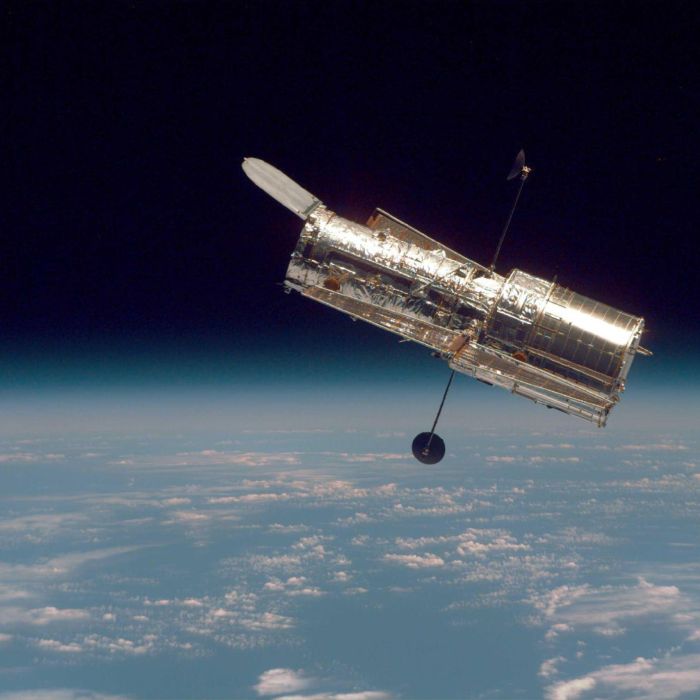
Hubble’s ultraviolet capabilities allow astronomers to examine spectral signatures that are difficult to measure from the ground. A spectrum separates light by wavelength, revealing features associated with particular atoms and gas motions. Absorption lines can indicate how gas is moving relative to a galaxy. By comparing these measurements with estimates of escaping ionizing radiation, researchers can investigate the connection between outflows and transparency. The telescope did not take a photograph of the entire reionization epoch unfolding. It measured physical conditions in more accessible galaxies that may offer clues to processes operating in the early universe.
Why nearby starburst galaxies are useful
Starburst galaxies form stars at unusually intense rates and contain populations of massive, short-lived stars. Those characteristics make them useful analogues for some early galaxies thought to have contributed to reionization. Nearby systems are brighter and easier to study in detail than extremely distant galaxies from the first billion years. The analogy has limits, however. Early galaxies may differ in chemical composition, structure and gas distribution. The researchers must therefore test whether relationships observed locally can be applied to ancient systems. The new result is evidence about a mechanism, not a direct census of all early galaxies.
What strong winds may actually do
One interpretation is that energy from supernovae stirs gas and dust into configurations that cover more of the young stars’ radiation sources. Material swept outward can create additional absorbing structures rather than simply opening a clear path. The details depend on gas density, geometry and timing. A strong outflow may coexist with a complicated network of clumps and shells that intercept photons. This helps explain why an apparently energetic galaxy might still have a low escape fraction. It also suggests that the spatial arrangement of material matters as much as the overall amount of energy released.
Timing may be the missing piece
The researchers suggest that ionizing photons may escape most efficiently before the first major supernova-driven winds develop. Young massive stars can produce intense radiation soon after formation, while the supernova explosions of some of those stars occur later. If smaller-scale processes create openings during that earlier period, photons could leave before large winds redistribute surrounding gas. This sequence offers a different explanation from the traditional picture. The study does not establish a universal timetable for every galaxy, but it highlights the importance of examining the order in which radiation, stellar feedback and gas motion occur.
What stellar feedback means
Astronomers use the term feedback to describe how stars and other energetic sources influence their environments. Massive stars emit radiation, launch stellar winds and eventually may explode, depositing energy and material into surrounding gas. These processes can regulate future star formation and reshape galaxies. Feedback is therefore not inherently positive or negative; it describes a set of interactions. The new research shows why modeling feedback as a single effect can be misleading. Radiation from young stars and mechanical energy from supernovae may have different consequences for the escape of ionizing photons at different stages.
Implications for computer simulations
Cosmological simulations attempt to model how galaxies formed and how radiation affected the early universe. Because they cannot resolve every small gas cloud or stellar interaction, researchers use simplified descriptions of physical processes. If those descriptions assume that powerful supernova winds always enhance photon escape, they may overestimate the contribution of certain galaxies. The Hubble result encourages modelers to examine earlier radiation-driven effects and the complex geometry of gas. This is not a declaration that all existing simulations are invalid. It is a reason to test their assumptions against a new observational relationship.
Why the study does not settle reionization
The universe’s reionization history depends on many factors, including the abundance of galaxies, their star-formation rates, the production of ionizing radiation and how that radiation travels through surrounding matter. The escape fraction is one part of the equation. Even a strong relationship between winds and photon escape in nearby galaxies cannot determine the entire cosmic history. Astronomers will need additional observations at different distances and wavelengths. The new findings narrow the plausible role of one mechanism while leaving room for other processes and variations among galaxies.
An international collaboration
The research involved nearly thirty scientists from institutions in several countries. Cody Carr, who led the work while at Zhejiang University and later joined the University of Michigan, was among the researchers examining the link between outflows and radiation escape. The team also included specialists in ultraviolet astronomy and galaxy formation. Such collaboration is important because interpreting spectra requires expertise in instruments, atomic physics and theoretical models. The resulting paper, published in Nature Astronomy, connects detailed observations of relatively nearby galaxies with a question about the universe more than thirteen billion years in the past.
What Hubble can still contribute
Although the James Webb Space Telescope has transformed observations of very distant galaxies, Hubble remains valuable for ultraviolet spectroscopy. Different observatories provide complementary measurements rather than making one another obsolete. Hubble can investigate nearby systems in wavelengths that reveal gas and radiation processes, while other instruments examine early galaxies and their broader properties. The team hopes to secure additional Hubble observations to test whether the relationship holds across a larger sample. Repeating the analysis could show whether the result is widespread or depends on particular types of starburst galaxies.
The next scientific test
Future observations should examine how photon escape changes with stellar age, wind speed, gas coverage and the structure of star-forming regions. Researchers will also compare the measurements with simulations that treat radiation and supernova feedback separately. A stronger account of reionization will require these pieces to fit together consistently. The immediate finding is more limited but still important: in the galaxies studied, stronger winds were associated with less escaping ionizing radiation. That challenges a long-standing expectation and gives astronomers a new direction for investigating how the early universe became transparent.
Frequently asked questions
What is cosmic reionization?
It is the period when energetic radiation ionized much of the neutral hydrogen between galaxies, allowing ultraviolet light to travel farther through space.
Did Hubble prove supernovae never help photons escape?
No. The study found a relationship in the galaxies observed that challenges a simple model of strong winds opening escape pathways.
Why study nearby galaxies to understand the early universe?
Nearby starburst galaxies allow detailed spectroscopy of processes that may also have occurred in early star-forming systems.
Research: Carr and colleagues, Nature Astronomy (2026). Institutional reporting: University of Michigan research announcement, October 30, 2026.