NASA’s October 30 Expedition 75 update details research on plant-cell division, fungal disease, exercise, virtual reality and semiconductor crystals aboard the ISS.
A research day after a major spacewalk
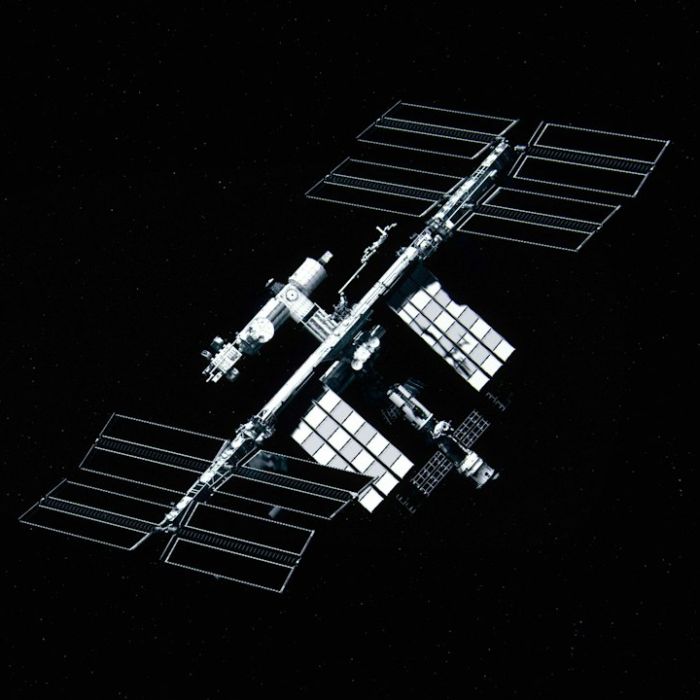
The International Space Station’s Expedition 75 crew returned to a varied scientific schedule on October 30, a day after two astronauts installed another roll-out solar array. NASA’s latest operations report describes experiments involving plant cells, crop disease, exercise equipment, semiconductor crystals, virtual reality and onboard decision-support technology. These activities are not a single breakthrough, but they show how an orbiting laboratory supports several research fields at once. The new solar array was already producing power, while the crew resumed investigations that may inform long-duration missions to the Moon and Mars.
Why space crops are receiving attention
Future crews traveling far from Earth cannot assume that every fresh food item will arrive through regular cargo deliveries. Plants may eventually provide dietary variety and help recycle resources, but they must grow reliably in unfamiliar environments. Microgravity changes the physical cues that cells and whole plants normally experience. Water distribution, root orientation and microbial behavior can also differ. Research on the station is intended to isolate some of those factors under controlled conditions. It is not proof that astronauts can already sustain a complete food system on another world.
Anil Menon’s work with plant cells
NASA astronaut Anil Menon worked in the Japanese Kibo laboratory module on an investigation of how microgravity affects cell division in green algae and cultured tobacco cells. These organisms offer researchers relatively accessible ways to study basic plant processes. Cell division is fundamental to growth, tissue formation and recovery from damage. If microgravity alters its timing or organization, engineers designing space agriculture may need to account for those effects. NASA said the results could support food-crop production for future lunar and Martian missions, but it did not announce experimental conclusions from Friday’s work.
Why algae and tobacco cells are useful
Algae and cultured tobacco cells are not being presented as the final menu for astronauts. They are research systems that can help scientists investigate cellular behavior without the complexity of an entire crop field. A cell culture can be exposed to controlled conditions and then examined for changes in division or development. Such studies may reveal whether gravity-related signals affect processes that plants normally carry out on Earth. The value lies in understanding mechanisms. Translating those findings into reliable lettuce, grain or other food production will require separate experiments with complete plants and realistic life-support systems.
A different experiment tackles plant disease
NASA flight engineer Luke Delaney investigated how plant disease resistance behaves in microgravity. He worked with thale cress, a small flowering plant widely used in biological research, after samples had been exposed to a fungal pathogen. Delaney inoculated the samples and placed them inside an incubator capable of generating artificial gravity conditions. The design creates opportunities to compare how plant-pathogen interactions respond to different gravity environments. The report describes the experiment’s procedure, not its outcome. Researchers will need to analyze the samples before concluding whether microgravity changes resistance or susceptibility.
Why an artificial-gravity incubator matters
Gravity can influence the distribution of fluids, cellular signaling and the way organisms grow. An incubator that generates artificial gravity provides a comparison condition for samples kept in microgravity. That helps researchers separate gravity-related effects from other influences such as temperature, lighting or handling. It does not reproduce every feature of an Earth greenhouse or a Martian habitat. Instead, it gives scientists a controlled experimental variable. Understanding which plant defenses change with gravity could eventually guide the design of crop systems that remain productive despite pathogens in confined spacecraft environments.
Food security has a terrestrial dimension
The research may also be useful for agriculture on Earth. Plant diseases threaten harvests, and learning more about how cells respond to pathogens can inform broader biological understanding. Spaceflight creates an unusual experimental setting that may reveal processes difficult to separate under ordinary conditions. However, it would be premature to claim that Friday’s experiment has produced a new disease-resistant crop or a treatment for fungal infections. NASA’s account identifies the investigation and its possible applications. Actual agricultural benefits will depend on published results, independent testing and the relevance of findings to field conditions.
Exercise remains essential in orbit
Canadian Space Agency astronaut Joshua Kutryk used the European Enhanced Exploration Exercise Device, known as E4D, in the Columbus laboratory module. The compact system is being evaluated for its ability to help astronauts maintain fitness during long missions. In microgravity, muscles and bones do not experience the same everyday loads as on Earth, making structured exercise especially important. Spacecraft have strict limits on mass, volume and power, so equipment that combines several functions could be valuable. The reported session is part of testing; it does not establish that E4D has already replaced existing exercise systems.
Virtual reality tests orientation
Roscosmos flight engineer Sergey Teteryatnikov used a virtual reality headset and responded to computerized visual stimuli during an experiment on balance and orientation. In orbit, astronauts lose the familiar gravitational reference that helps people interpret up and down. The brain must adapt to information from the eyes and inner ear under unusual conditions. Virtual reality can present controlled visual scenes while researchers observe responses. Such work may help explain adaptation and inform training, but the NASA report does not provide quantitative results from the session. It describes a research activity rather than a validated new therapy.
Semiconductor manufacturing in microgravity
Station commander Pyotr Dubrov changed hardware inside a temperature-controlled chamber for a physics investigation of high-purity semiconductor crystals. Crystal growth can be sensitive to fluid movement, temperature gradients and impurities. Microgravity may allow scientists to study some processes with reduced buoyancy-driven convection, although other forces remain. The aim is to understand whether certain materials can be produced or characterized differently in orbit. Commercial manufacturing would require evidence of reproducible quality, economic viability and a clear advantage over Earth-based processes. Friday’s work was an experiment, not a declaration that space-made chips are ready for market.
Why the science freezers are important
NASA astronaut Jessica Watkins serviced portable science freezers used to store samples for eventual analysis on Earth. She replaced moisture absorbers and performed other maintenance tasks. Preserving a sample’s condition is often essential to obtaining reliable scientific results. If biological material warms unexpectedly or moisture damages equipment, the data can become harder to interpret. Freezers therefore form part of the station’s research infrastructure rather than simply providing storage. Their maintenance may be less dramatic than a spacewalk, but it helps protect the integrity of experiments that depend on careful sample handling.
Watkins also serviced experiment hardware
Watkins removed and photographed components from equipment that powers experiments launched aboard spacecraft. Documentation matters in a laboratory where engineers on Earth cannot walk into the room to inspect a malfunction. Photographs can help teams assess wear, installation and component condition. Routine servicing also supports continuity across missions and crew rotations. The operations update did not identify a major failure or a newly discovered defect. It reported planned technical work that keeps the research environment usable. Such maintenance is part of the cost and complexity of operating a laboratory hundreds of kilometers above Earth.
Studying smarter onboard operations
Roscosmos flight engineer Anna Kikina investigated how advanced decision-support tools might improve spacecraft operations and communications. NASA described the activity as a study of super intelligence tools, without reporting a deployed autonomous system or measured performance improvement. On deep-space missions, communication delays can make crews more dependent on onboard information and procedures. Tools that organize data or assist decisions could eventually be useful, but they must be reliable, understandable and subject to human oversight. The experiment should not be interpreted as evidence that artificial intelligence is independently controlling the station.
The power upgrade is part of the context
The preceding day’s spacewalk by Menon and Kutryk lasted seven hours and eleven minutes and installed a roll-out solar array on the station’s port truss. NASA said the new array was generating power. Another spacewalk was scheduled for November 5 to install the eighth and final roll-out array, with the overall upgrade intended to raise generating capacity from about 160 to 215 kilowatts. This infrastructure work is relevant because scientific operations depend on electrical power. Yet Friday’s research update is a separate story about the experiments that use the station’s laboratory facilities.
What scientists will learn later
The value of the October 30 activities will become clearer when researchers analyze the plant samples, compare exercise performance, evaluate orientation responses and publish results from materials investigations. Not every experiment produces a headline discovery, and many require repeated sessions before conclusions can be drawn. The station’s importance lies partly in offering a controlled environment where gravity can be treated as an experimental variable. The latest update shows the breadth of that work: biological questions, human performance, manufacturing and spacecraft operations all being investigated during the same day in orbit.
Frequently asked questions
What plants were studied on the ISS?
The reported activities involved green algae, cultured tobacco cells and thale cress samples exposed to a fungal pathogen.
Did the crew discover a new way to grow food in space?
No results were announced. The experiments investigate plant cell behavior and disease resistance under different gravity conditions.
Why are astronauts testing new exercise equipment?
Long missions require reliable ways to maintain fitness while minimizing spacecraft equipment mass and volume.
Primary source: NASA International Space Station blog, October 30, 2026.