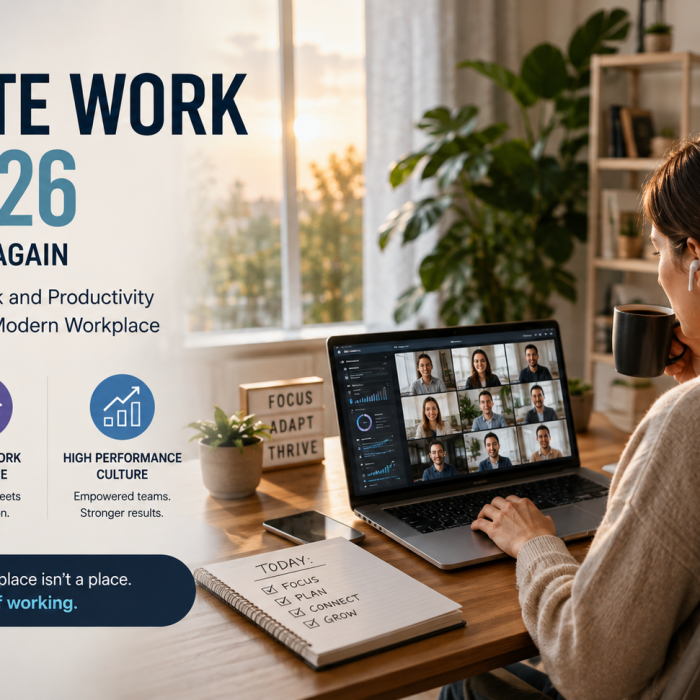
The Death of the Endless Meeting: Why Asynchronous Work Is Becoming Essential in 2026
There is a strange contradiction in the modern workplace.
Technology was supposed to make communication easier.
And it did.
We can now message colleagues instantly, schedule a video call within seconds, share documents across continents and receive updates from dozens of people throughout the day.
But somewhere along the way, communication became the work.
Employees open their laptops in the morning and immediately find themselves surrounded by:
- Emails
- Slack messages
- WhatsApp notifications
- Video meetings
- Calendar reminders
- Project updates
- Follow-up calls
- “Quick questions”
By the end of the day, many people have been busy constantly communicating but haven’t had enough uninterrupted time to actually do their jobs.
That is why asynchronous work is becoming one of the most important workplace conversations of 2026.
The idea is simple:
Not every message needs an immediate response.
Not every discussion needs a meeting.
And not everyone needs to be online at the same time to work effectively.
For remote and hybrid teams, that could be a major shift.
The Modern Workplace Has a Focus Problem
Most knowledge workers don’t struggle because they have nothing to do.
They struggle because they have too many interruptions.
A person might begin writing an important report.
Ten minutes later, a message arrives.
Then another.
A colleague asks for a quick call.
A calendar reminder appears.
The employee returns to the report but now needs time to remember where they stopped.
Then the cycle repeats.
The problem isn’t necessarily laziness.
It’s fragmented attention.
Modern work has become increasingly dependent on constant availability.
Employees often feel pressure to respond immediately because silence can be interpreted as inactivity.
But being constantly available is not the same as being productive.
What Is Asynchronous Work?
Asynchronous work means employees do not have to communicate or respond at exactly the same time.
Instead of requiring everyone to join a meeting at 10 AM, information can be shared through a document, recorded video, project-management platform or written update.
A team member can review that information when they are available and respond thoughtfully.
Examples include:
- Recorded video updates
- Written project briefs
- Shared documents
- Task-management tools
- Decision logs
- Internal knowledge bases
- Scheduled messages
- Recorded presentations
The goal isn’t to eliminate real-time communication completely.
The goal is to use it only when it is genuinely necessary.
The Difference Between Async and “Always Online”
Remote work was initially supposed to give people flexibility.
But for many employees, it created the opposite.
Because work happens online, employees can technically be contacted at any moment.
This creates an unhealthy expectation:
If you’re online, you should respond.
Asynchronous work challenges that idea.
It allows employees to focus on their work without feeling guilty about not answering every message immediately.
Instead of measuring responsiveness in seconds, teams measure progress over meaningful periods of time.
Why Meetings Are Becoming a Productivity Problem
Meetings aren’t always bad.
A good meeting can solve a complicated problem in thirty minutes.
A bad meeting can waste the time of ten people for an hour.
The real issue is that many organizations schedule meetings by default.
Need an update?
Schedule a meeting.
Need a decision?
Schedule a meeting.
Need to explain something?
Schedule a meeting.
Before long, calendars become full.
The employee spends the day moving from one call to another and tries to complete their actual work in the small gaps between meetings.
That’s not collaboration.
That’s calendar management.
The Hidden Cost of a One-Hour Meeting
A one-hour meeting involving eight people is not really a one-hour meeting.
It represents eight hours of organizational time.
And the real cost can be even higher.
Employees need time before meetings to prepare.
They need time afterward to process decisions.
A meeting can also interrupt deep work.
If someone has an important meeting at 2 PM, they may avoid starting a complicated task at 1 PM because they know they will soon be interrupted.
The meeting therefore consumes more than its scheduled duration.
This is why companies are increasingly asking an important question:
Could this meeting have been a document?
Why Remote Teams Need Async Communication
Asynchronous work becomes especially valuable when teams are distributed across different locations.
Imagine a company with employees in:
- India
- London
- Dubai
- New York
- Singapore
Finding a convenient meeting time for everyone can be difficult.
Someone will always be joining early in the morning or late at night.
Async communication solves part of this problem.
Instead of requiring everyone to attend live, information can be documented.
Employees can contribute during their own working hours.
This creates a more global workplace.
Documentation Is Becoming a Superpower
One of the biggest benefits of asynchronous work is better documentation.
In traditional workplaces, important information often lives inside conversations.
Someone discusses a decision during a meeting.
A few people remember it.
Others don’t.
Weeks later, someone asks:
“Why did we decide this?”
Nobody is completely sure.
Async teams try to solve this by documenting important information.
This might include:
- Project decisions
- Responsibilities
- Deadlines
- Company policies
- Meeting summaries
- Product changes
Good documentation reduces dependency on individual memory.
It also makes onboarding easier for new employees.
But Async Work Doesn’t Mean No Human Interaction
One common misunderstanding is that asynchronous work means employees should never talk to one another.
That’s not the goal.
Humans still need conversations.
Teams need relationships.
Managers need to understand how employees are doing.
Some problems are easier to solve in real time.
The best approach is usually a combination.
Use asynchronous communication for:
- Updates
- Documentation
- Routine questions
- Status reports
- Feedback
- Information sharing
Use synchronous communication for:
- Complex problem-solving
- Brainstorming
- Sensitive conversations
- Relationship-building
- Emergencies
- Important negotiations
The goal is not fewer conversations.
It’s better reasons for having them.
AI Could Make Async Work Even More Powerful
Artificial intelligence is now adding another layer to asynchronous collaboration.
AI can help teams:
- Summarize long discussions
- Create meeting notes
- Organize information
- Generate project updates
- Search company knowledge
- Translate communication
- Identify action items
Recent analysis published by Harvard Business Review in September 2026 argues that AI can improve teamwork when it is intentionally incorporated before, during and after collaborative work rather than being treated only as an individual productivity tool.
This is an important shift.
The future of workplace AI may not simply involve individuals asking chatbots questions.
It may involve teams using AI to reduce communication friction.
The Inbox Is Becoming Another Productivity Crisis
Meetings are only one problem.
Email is another.
Many employees return from holidays and immediately face hundreds of unread messages.
Recent research released by Zoom in September 2026 found that 61% of surveyed knowledge workers dread the work waiting for them after paid time off, while 48% reported feeling anxious even before their time away begins.
That tells us something important.
Employees aren’t always avoiding vacations because they don’t want rest.
Sometimes they are avoiding the consequences of coming back.
An overflowing inbox has become part of the modern workplace experience.
Async Work Can Protect Deep Work
Some tasks require uninterrupted concentration.
Writing.
Programming.
Design.
Research.
Strategic thinking.
These activities don’t work well when interrupted every few minutes.
Asynchronous communication creates space for deep work.
Instead of constantly checking messages, employees can establish communication windows.
For example:
- Check messages at 10 AM
- Focus from 10:30 AM to 12:30 PM
- Review communication after lunch
- Complete another focus block
This doesn’t mean ignoring colleagues.
It means protecting concentration.
Why Managers Need to Change Their Thinking
Asynchronous work requires trust.
Managers who believe employees must constantly prove they are working may struggle with the concept.
The old management model often depends on visibility.
You see someone at their desk.
Therefore, you assume they are working.
Remote and async work make this approach less useful.
Managers need to focus on:
- Results
- Deadlines
- Quality
- Customer outcomes
- Project progress
Not simply:
“How quickly did they reply to my message?”
This is one of the biggest cultural changes required for modern work.
The Return-to-Office Debate Makes Async More Important
Recent workplace research shows there is still no universal model for where people should work.
A September 2026 study of organizational remote-work policies found that hybrid work remains widespread, with many companies requiring some office presence while still allowing flexibility.
The question is no longer simply remote versus office.
Even employees sitting in the same building can benefit from asynchronous communication.
A team can be physically together and still waste hours in unnecessary meetings.
Async work is therefore not only a remote-work strategy.
It is a better-work strategy.
How Companies Can Introduce Asynchronous Work
Businesses don’t need to transform everything overnight.
They can start with small changes.
1. Create Meeting-Free Focus Blocks
Protect several hours each week from unnecessary meetings.
2. Write Better Updates
Replace routine status meetings with written updates.
3. Document Decisions
Important decisions should be easy for employees to find.
4. Set Response Expectations
Not every message requires an immediate reply.
Define reasonable response times.
5. Record Important Presentations
Allow employees to watch when convenient.
6. Reduce “Reply All” Culture
Only involve people who genuinely need the information.
7. Use AI Carefully
Use AI to summarize and organize communication, while maintaining human review where accuracy matters.
What Employees Can Do
Individuals can also improve how they work.
Try:
- Turning off unnecessary notifications
- Blocking focus time on your calendar
- Writing clear messages
- Avoiding unnecessary meetings
- Documenting important decisions
- Using recorded updates where appropriate
- Checking communication intentionally rather than constantly
The goal is not to become unavailable.
The goal is to stop allowing every notification to control your day.
The Future Workplace May Be Quieter
For years, workplace culture rewarded visibility.
The loudest person.
The fastest responder.
The employee always available.
But the future may reward something different.
The person who can:
- Think clearly
- Work independently
- Communicate effectively
- Document knowledge
- Collaborate intentionally
- Deliver meaningful results
Asynchronous work creates an environment where those skills become more valuable.
And perhaps the biggest productivity revolution of the next few years won’t come from another app.
It may come from learning when not to communicate immediately.
Conclusion
The biggest productivity problem in modern work may not be that employees aren’t working hard enough.
It may be that they are interrupted too often to do their best work.
Meetings, emails and notifications have created a culture of constant communication. But constant communication is not the same as effective collaboration.
Asynchronous work offers a different approach.
Communicate clearly.
Document important information.
Respect people’s focus.
Meet when it matters.
And stop treating immediate responses as the ultimate measure of productivity.
In 2026, the smartest companies may not be the ones with the busiest calendars.
They may be the ones that finally give people enough uninterrupted time to actually think.
Frequently Asked Questions
Asynchronous work is a way of working where employees do not need to communicate or respond at the same time. Teams use written updates, recorded videos, shared documents and digital tools to collaborate across different schedules.
It can be especially useful for remote and distributed teams because it reduces the need for constant meetings and allows employees in different time zones to contribute more flexibly.
No. The goal is not to eliminate all meetings. Realtime conversations remain useful for complex decisions, brainstorming, sensitive discussions and relationship building.
Companies can replace routine meetings with written updates, recorded presentations, shared documents and project-management tools while reserving live meetings for work that genuinely requires real-time collaboration.
Yes. AI can summarize discussions, organize information, identify action items and improve access to knowledge, although important outputs should still be reviewed by humans.